Showing posts with label of. Show all posts

Kanji Can-Can


I think it’s high time that I talked up kanji in this wayward blog.

While I’d like to assume that most people know precisely what I’m on about, I guess I should throw in a morsel for those people not so interested in things Japanese: In case you don’t know, kanji is the stuff you see on scrolls and painted in big black letters on banners – logographic Chinese characters used in the modern Japanese writing system.

Sometimes in movies you see people dabbing big brushes in ink and artily doing strokes across washi paper.

Kanji is grammatically flexible – it can twist itself into nouns and adjective and verb stems – and personally I have a delight/despair affair with the beasties. It’s a bugger to remember the thousands of characters and their various pronunciations, let alone acquire the talent to reproduce the multitude of lines.

To make things trickier, a single kanji may be used to write one or more different words, and deciding which one depends on context, intended meaning, use in compounds, and/or sentence location.

While I’ve loved the simpler Japanese katakana lettering since I was a kid (when I first saw neon Tokyo signage through the eyes of Cubby Broccoli’s film crew in the Sean Connery-James Bond flick You Only Live Twice), I’ve had a more cautious, developing relationship with kanji that probably started with Akira Kurosawa’s Ran in my early 20s.


So the funny thing is that kanji, not katakana, made such a big impact on the novel I published last month – which is based in Melbourne, Australia, not Tokyo, Japan.

The first completed treatise of what’s now known as Tobacco-Stained Mountain Goat was completed in 1992, while I was living in Richmond, an inner city suburb of Melbourne, and there was nothing Japanese about it whatsoever.

But when I moved to Tokyo in 2001, the seepage began to set in.

I wrote up a redux of the decade-old tome the following year – and thereafter again let it sit pretty, collecting dust, for the five years leading up to 2007. Then I did a major reboot, was accepted for publication through Another Sky Press in the U.S., and rewrites and editing took the better part of the next three years.

Somewhere along the line inserting kanji into the text became a big part.

As I mentioned, in 1992 there was none, not even mention of our protagonist Floyd's tattoo fuyu (‘winter’) – probably because I didn’t get it myself until 1994 in a particular winter of discontent; that’s something Floyd and I share, aside from drinks.

Likely the kanji settled itself in my brain 15 years later, after I’d watched in excess of a dozen Akira Kurosawa movies on the trot (all within one week) at the beginning of 2010.

While I do love Kurosawa and would readily volunteer myself to sit through this process another time round, there was a reason for my committed viewing: an article I was writing for Australian magazine Filmink to celebrate the centennial since the great man’s birth.


In Kurosawa films there’s occasionally kanji that dominates the screen all by itself – accompanied by a sparse, minimal score by a composer like Fumio Hayasaka or Toru Takemitsu – and it's powerful stuff even if you can’t understand what the devil it says.

So in Tobacco-Stained Mountain Goat I decided to do a Kurosawa and throw in meaningful kanji, some of which isn’t even explained in the text – meaning that anyone who scoots through this piece will have a wee bit more insight than anyone having read the book.

IF VAGUELY INSPIRED, YOU CAN READ MORE OF THIS ARTICLE @ FORCES OF GEEK.

Production I.G slides out Drawer Hobs


I’ve also had a great relationship with Production I.G over the past six years or so thanks, chiefly, to Francesco Prandoni at the International Operations division.

We’d done stuff together before on Tokyo Marble Chocolate and Mamoru Oshii’s Assault Girls, and two months ago, just before the earthquake kicked this country in the stomach, I had the absolute pleasure of working again with Francesco on the English subtitles for a brand new anime feature from Production I.G.

It’s called Drawer Hobs (Tansuwarashi たんすわらし in Japanese), and what it lacks in the action/mecha quotient the story more than makes up for with a playful sense of humour and a refreshing, quirky and whimsical look at contemporary life in this city – giving even more clarity post-tremblor.

Plus it has a range of oddbod kids that reside in a chest of drawers and do such offbeat chores as checking earthquake safety (ironic), cooking up feasts, drinking beer, and wild girls’ makeovers.

But the power here is not just in the visual content or the surreal nature of the yarn – both of which are superb, by the way. It’s the real people involved here who take the venture into lofty territory.

You can read more about I.G's plans for world domination @ Forces Of Geek.


DRAWER HOBS © 2011 Kazuchika Kise/Production I.G/Japan's Agency for Cultural Affairs

Qantas: the Fillet of Australia?


I hate to be somewhat moronic here and spin a droll comment on a corporate logo - that's done enough in this world on cantankerous blogs as much as in the 'professional' media.

It's also a bit passe. But I'm a little angry, and whether or not a concept is old hat or not doesn't really swing for me at the moment.

The thing is, if Qantas truly is the Spirit of Australia, then the email I just got from them is a sad state of affairs and makes me ponder swapping citizenship.

Regardless of whether or not you've read anything else in these pages, most people would know about the March 11 earthquake in the Tōhoku region of Japan, and the resultant aftershocks and problems with the Fukushima nuclear power plants.

Obviously these have been of a tiny bit of concern to even those of us here in Tokyo, though we're 230km away; the water supply was briefly (and marginally) effected by radiation, and while things now seem to be coming under control, for a few weeks there no one knew what to expect.

During that time my family and I discussed options, including the possible need to fly out of the country.

I've been a member of Qantas Frequent Flyers since the mid 1990s, and a Qantas aficionado since flying as a wee tacker with the old TAA domestic airline in the 1970s (it was incorporated into Qantas). In English lessons I teach, Qantas occasionally comes up and in those moments I've got all star-struck and proudly mentioned the airline's longevity (it's the third oldest in the world), good safety record and the origin of its acronym (Queensland and Northern Territory Aerial Services).

So, being a bit of a fan and veteran frequent flyer, I decided to check how many points I had on my Qantas account - and discovered there were zero.

This was news to me. If they don't want to pay postage costs to Japan (and fair enough to), then the company could at least email me (free) to advise that they're deleting in excess of 10,000 frequent flyer points, with a reason as to why.

But I'd heard nothing.

Being a long-time customer, a fellow Aussie, and in a potentially diabolical situation, I wrote to Qantas early on in April as follows:

Dear Sir/Madam,

This is Andrew Bergen, an Australian based in Tokyo, Japan, for 10 years now. I hope you can help me to sort out a matter of surprise and relative discomfort.

I have been a long-time member your Qantas Frequent Flyer program, and while I may not fly so regularly now (I have a young family with a five-year-old daughter), we are preparing ourselves for the worst here in Japan, and looking at flying out if the situation with the nuclear reactors happens to worsen.

I was under the impression that I had 10,000+ points on in my Frequent Flyer account, but when I checked just now it appears that I now zero points - because 10,169 points were deducted from my account on 28 February 2010, but I was not warned about this in advance, or otherwise advised of the deduction, until I checked today.

Is there some time limit imposed on points? I wasn't aware of any expiration date on points.

And in the circumstances, would it be possible to waive such time limits? These points would certainly help us (in a small way) to pay for the three tickets we will need to leave Japan in an emergency.

I hope you can help us further,

All the best,
Andrew Bergen


Almost two weeks passed before I received the courtesy of a reply, so I'm grateful that the reactors up north have been as patient as we have.

Unfortunately it wasn't quite what I'd hope to hear. While I'm no stranger to bureaucratic corporate policy trumping basic human decency, it's still sad to see long-time loyalty to a huge, profitable company respected... with nothing at all except a notion of brushed-off indifference:

Dear Mr Bergen,

Thank you for contacting The Qantas Club and Frequent Flyer Service Centre.

I'm unable to reinstate your points that expired in February 2010.

Your points expired because there wasnt any activity on your account over a three-year period. We make every effort to let our members know the status of their points through their online Activity Statements.

If youd like to know more about the Frequent Flyer program, please visit qantas.com/frequentflyer where youll find full details of your membership benefits, along with our latest news and offers.


The Spirit Of Australia my arse - and for god's sake get a spell-checker next time you mail me.

Coincidentally, two days ago I lost a few cards while on my way to work in Kanagawa. One of those cards was my worn out old Qantas Frequent Flyer Card.

To whomsoever finds it: keep the thing. Souvenir it. I don't need the card now, and certainly won't be replacing it.

Unchain My Heart (Catch)


This past week something special ended for me, and while I wouldn’t quite put it in the same league as the final episodes of Buffy the Vampire Slayer, Xena: Warrior Princess or Battlestar Galactica, it still feels like a kick in the gut and has left me feeling strangely down in the dumps.

I’m talking about the 49th episode of anime series HeartCatch PreCure!, which was broadcast on Sunday morning here in Japan. HeartCatch is the seventh version of the long-running girls' concept created by the “mysterious” Izumi Todo – actually none other than an alias for the creative types at Toei Animation.

I've known all along that production house Toei reinvent their Pretty Cure anime series every February, and that they'd done so seven times already since 2004, so I could see the writing on the wall for this particular incarnation from the moment it started in February, 2010.

Each year there’s a new super-team of Pretty Cure girls to battle baddies and dress in glitzy new ways, taking the baton from Sailor Moon but at the same time making that predecessor seem underplayed.

You can read more of this rambling yarn and about the end of HeartCatch @ the Forces Of Geek site.

Now for new incarnation Suite PreCure ♪ tomorrow.

IMAGE COPYRIGHT
© ABC 東映アニメーション

SPOTLIGHT: Nausicaä of the Valley of the Wind


Writer/director Hayao Miyazaki dabbled with plucky women in his anime previously, most notably with the character of Fujiko Mine in the Lupin III series – see The Castle of Cagilostro (1979) just for starters.

He also had younger heroines like the Pippi Longstockingesque Mimiko in Panda! Go Panda!

But in 1984, in Kaze no Tani no Naushika (風の谷のナウシカ Nausicaä of the Valley of the Wind), with Nausicaä herself – the heroine of this sci-fi/post-armageddon action/fantasy tale, and saviour of the world it chronicles – we see the tell-tale signs of female strength that invade later Miyazaki classics like Sen to Chihiro no Kamikakushi (千と千尋の神隠し Spirited Away, 2001).

The story here revolves around a world treading water (rather than on the mend) a thousand years after the apocalyptic war that’s poisoned the environment. Scattered settlements fight to survive, and one of these is the peaceful Valley of the Wind. The people here are ruled over by an ailing king and his willful, charismatic daughter Nausicaä – and all soon find themselves in a struggle not only with menacing giant insects but against militias from rival kingdoms and the threat of a return to the destructive old ways.


Amidst the action, intrigue, prophecies and surreal toxic jungle set-pieces are another couple of Miyazaki’s favourite themes: an appreciation of and support for the natural world around us, fantastic flying machines, and a huge, destructive robot.

Most Japanese people you meet will know this movie, they’ve all seen it as kids (and often as adults), and many cite it when they talk about favourite anime movies in their lives.

It’s rated in the personal Top 5 for anime director Kenji Kamiyama (Eden of the East), and Tokyo DJ/producer Jin Hiyama rates Nausicaä as his second-favourite anime movie of all time. “It’s the combination and comparison of this grotesque world with her beautiful mind and her honesty,” he raves.

It also has one of the best, most memorable soundtracks ever composed by the prolific Joe Hisaishi (Hana-bi). I've lost count of how many times I've heard little kids and their parents humming the iconic theme music.

Still, there are some important things to keep in mind when it comes to Nausicaä.

For starters the earlier manga series (also by Miyazaki) is a far more comprehensive and telling journey.

“You must read the manga,” urges musician Lili Hirakawa. “While the movie is great, it doesn’t tell you nearly enough about this world."


Additionally, this ground-breaking movie originally entered the West back in the ‘80s via a badly dubbed and horrendously edited version on VHS called Warriors of the Wind – an excruciating cut that makes little sense and a bitter learning curve for both Miyazaki and Studio Ghibli, who've since insisted on a “no edits” overseas licensing clause.

The edits, however, have nothing on the cover.

That art (left) from the video cassette didn't even feature principle character Nausicaä at all - save for that lame ring-in in the top right-hand corner. Instead the foreground is dominated by a trio of males characters I'm pretty certain aren't in the film at any point, not even closeted away driving the tanks.

Fortunately an uncut and re-dubbed DVD version of Nausicaä of the Valley of the Wind, with (even better) the original Japanese dub and good English subtitles, became available around the world in 2005, although I picked up my copy earlier on from Studio Ghibli here in Japan.

And the verdict on the ‘real’ version, in spite of the disclaimers? Quite simply brilliant - just avoid that VHS predecessor at all costs.


© 1984 Nibariki - GH

Love Songs


What music do you like to make love to?

A simple question, really.

“Sometimes I sing ‘Danger Zone’ in the bathroom. I like the music from Top Gun. When I was a child I dreamed of becoming a fighter pilot, and to this day Top Gun is my favorite action movie. But this is not bathroom music,” laughs Takashi Watanabe.

“Hmm. I think jazz house, because of swing and the punchy hi-hat accents and R&B horn riffs.”

As DJ Warp, Watanabe usually spins far harder techno and tech-house tunes.

Toshiyuki Yasuda, who makes music under his own name as well as doing vocoder crooning as Robo*Brazileira, jumps at the opportunity to answer this one. “Coleman Hawkins’s ‘Body and Soul’,” he cites.

“It never repeats the same riffs or theme throughout the tune, so I feel fresh and stimulated each time I listen to it - which is important for it, isn't it? Although actually no music is really the best, I think.”

“I like deep and dark minimal because it makes me erotic,” suggests Rie Kurihara (better known as veteran DJ/producer Ree.K), and then she goes one step further and debunks the idea in agreement with Yasuda.


The rest of this article is online HERE at Forces Of Geek.

Old Relics of Tokyo 東京


You’ll still find the structures in obscure narrow alleyways in downtown areas, or even in parts of Ginza - one of the most luxurious shopping districts in the world and the most expensive real estate in Japan - like this samurai armor shop (right) that I stumbled across last year.

I’m talking up architecture.

And no, not the newer, over-the-top miracles of stone, glass, plastics and metals that crop up in Odaiba and Ginza and Aoyama. This month I decided to peer instead into the rear vision mirror, looking for the sense of history that (sometimes) feels like it’s sadly lacking in this metropolis.

You can forget the ancient temples and shrines; they already get plaudits even though most of them have been recommissioned or rebuilt after the general destruction of the Great Kanto earthquake (1923), fires, and the Allied carpet bombings during World War 2.

So what precisely am I thinking?


Well, the wooden abodes, quite often plastered; they’re simple houses, shops and other treats with shoji doors and strange takes on the “bay window” concept.

You’ll see them poking out behind people in old Japanese movies like Yasujiro Ozu’s Tokyo Story (1953) and Akira Kurosawa’s Drunken Angel (1948) or Ikiru (1952), most built before or during the Taisho period (1912-26) or early Showa era (1926-89).

When I moved into my apartment in Okusawa, near Jiyugaoka, five years ago there was a brilliant two story derelict house just round the corner (see picture above left). As-yet-unslain curiosity cat that I am, I just had to investigate.

The place was open to the street, yet—as per most Japanese derelict abodes—no squatters had ever lived there. In the drawers were old clothes including dusty kimonos, and while the tatami mats were water-logged and buckled up, and the building wasn’t in the best condition, it could’ve been fairly easily renovated.

Six months later it was torn down and replaced with a car park for the apartment block next door.


* The remainder of this self-opinionated rant is online now @ FORCES OF GEEK.

Japanese Musicians Rule OK! (Part 2)


Two weeks back for my hack Flash in Japan column over at Forces of Geek I did a feature story on a bunch of cool, talented and rather diverse musicians based in this country (Japan), asking for the feedback on a swag of hotch-potch questions.

We ended up with far more material than we could run in one sitting, so we called that Part 1; without much further ado here’s Part 2 - kept nice and relatively simple - with the further feedback from Masaya Kyuhei, aka DJ Q’hey, Tsuyoshi K, alias producer Cut Bit Motorz, Akiko Kiyama, Ko Kimura, Takashi Watanabe (aka DJ Warp), DJ Wada (Shuji Wada from Co-Fusion), Tatsuya Oe (Captain Funk), Jin Hiyama, Toshiyuki Yasuda and Lili Hirakawa.

Luckily none of these people objected to my more obscure, self-indulgent queries—which this time around all related to that most essential of topics: anime and manga.

HEAD ON OVER HERE.

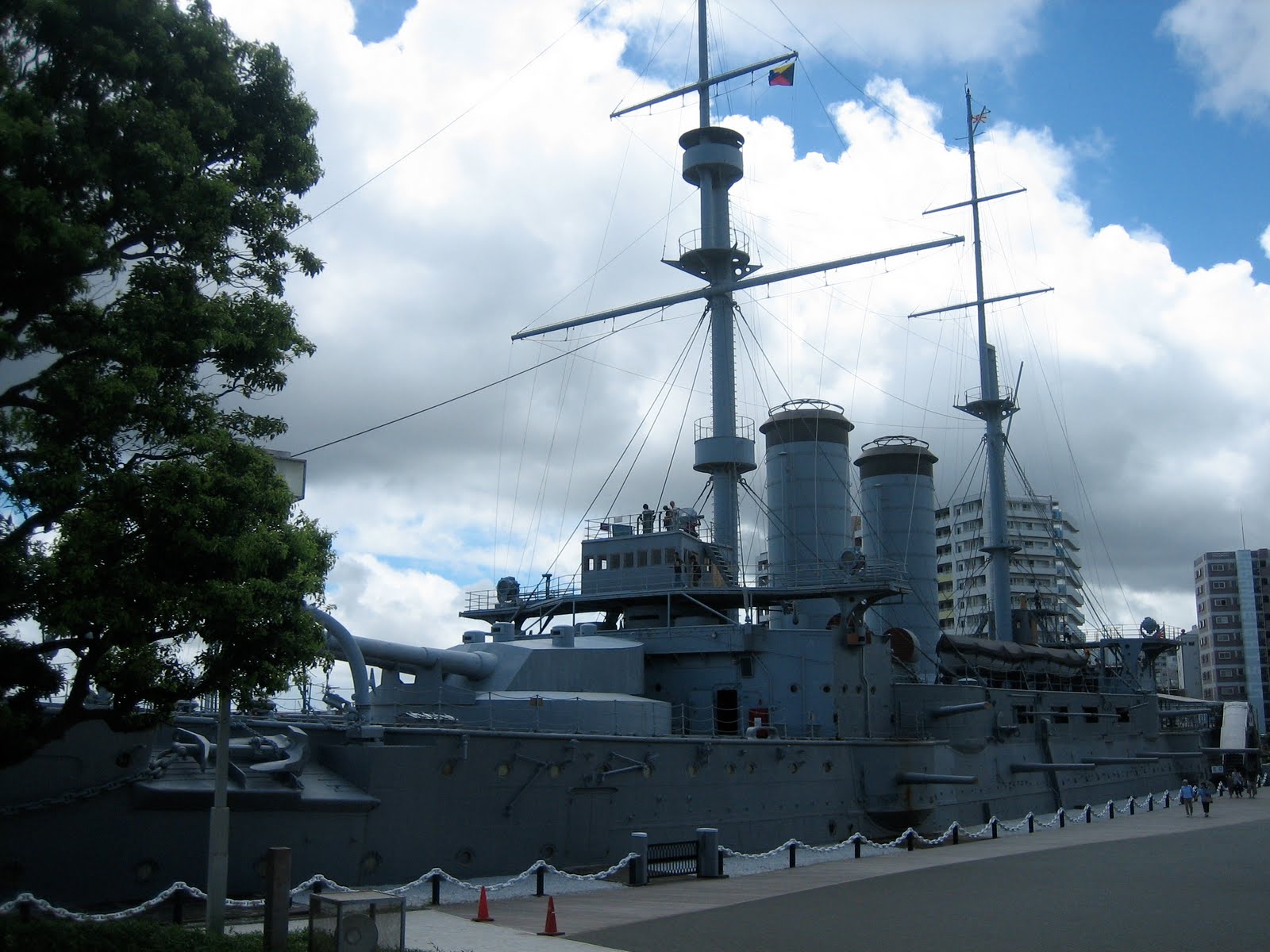
Battleship Mikasa 三笠


Yesterday I went to Mikasa Park - and much as that may sound like the Japanese equivalent of a song penned by Jimmy Webb, it's in fact a stately space by the seaside in Yokosuka, located right next the U.S. naval base there.

A previous resident of Yokosuka was William Adams, the inspiration for the British hero John Blackthorne in James Clavell's tome Shōgun, back in the 17th century; he was more recently channeled by Richard Chamberlain in the 1980 TV miniseries.

It was also in the southern part of Yokosuka in the mid 1850s that Commodore Matthew Perry arrived with his fleet of Black Ships, to force the opening of diplomatic and trade relations between Japan and the United States.

Almost one hundred years later American occupation forces landed at Yokosuka (on 30 August 1945, after the surrender of Japan) and the naval base has been used by the US Navy since then.


Yokosuka crops up as the locality of the Sega video game Shenmue, as well as being blown up in the futuristic tactical RPG Front Mission 3.

Director Imamura Shohei set his 1961 film Pigs and Battleships (豚と軍艦) in Yokosuka, and the place was the location of climactic fisticuffs in the Godzilla film Terror of Mechagodzilla (メカゴジラの逆襲, 1975).

But the real reason I went down there was for an exceptionally big ship.

The Mikasa is a pre-dreadnought battleship ordered from Britain by Japan in 1898 and took three years to complete, at the cost of £880,000 (¥8.8 million). Upon arrival in these waters the ship ended up becoming the flagship of Admiral Heihachiro Togo, Commander-in-Chief of the Japanese Grand Fleet during the Russo-Japanese War (1904-1905).


Named after Mount Mikasa in Nara, the Mikasa is in fact the last pre-dreadnought ship in the world, a survivor of the Russian conflict, running aground in fog in 1921, decommissioning later that year, retirement as a memorial ship in 1926, bombing in World War 2, and extensive dismantling during Japan's demilitarization thereafter.

Restoration work, in conjunction with the U.S. Navy, brought the old lady back to life and she was opened to the public in 1961. Now it's a nifty museum with its own cinema, models, paintings and documents, many of the compartments look as they did in Togo's time, and there're some hilarious mannequins "manning" cannons.

The main guns (seen above with a ring-in, unsuspecting live bystander to get a gist of their size) had a range of 10 kilometres and fired projectiles weighing 400 kilograms. It took 40 people to operate them, surrounded by armour weighing in at around 50 tons.


The ship was the major setting for Nihonkai Daikaisen: Umi Yukaba (1983) - variously known in English as Battle of the Japan Sea and Battle Anthem, it tells the story of a young musician assigned to Mikasa’s shipboard band, and depicts the Battle of Tsushima Straits in 1905.

At Tsushima the Mikasa led the combined Japanese fleet into one of the most decisive naval battles in history - almost annihilating their Russian foes.


The movie starred the great Toshiro Mifune as Admiral Togo; it was directed by Toshio Masuda, who helped make Tora! Tora! Tora! in 1970 as well working on the anime Space Battleship Yamato series - and was involved as the producer on its 2009 reboot Rebirth Yamato.


There's also an NHK drama called Sakanoue no Kumo, screened last year, which portrays a rapidly modernizing Meiji Japan (1867-1915) and has extensive location and press shots around the Mikasa.

But the best find of this little expedition was the Admiraali Export Beer with Admiral Togo's face on it (see first picture above), which I'm partaking of now as I write these words.

It's quite the tasty amber drop. Yum!

Ryoji Arai: An Artist Between The Worlds


To be honest it’s quite probable that, if you live outside Japan, you haven’t yet heard of Ryoji Arai or of the animated TV series Sukima no Kuni no Polta (Polta: A Country Between The Worlds).

My hope is that some day everybody will get the chance.

First regarding the TV series: Polta’s initially short run on Japanese national broadcaster NHK in 2006 generated such a hugely positive response from critics and TV viewers alike in this country that it prompted production company Aniplex to generate a new batch the following year; it’s been on repeat in various time slots ever since.


While ostensibly aimed at kids no taller than most people’s kneecaps, Polta is such a gamely surreal romp that it comes across as deliriously upbeat and gloriously quirky all at once – due in no small shrift to the original character designs by Ryoji Arai, a man rightly considered the best kids’ book artist in Japan, and a one-time winner of the Astrid Lindgren Memorial Award in this field.

“I was really surprised!” Arai says now of that honor, which he won in 2005 for the book Refrain Refrain.


...the rest of this interview/story has just been chucked up on the way cool Forces Of Geek website, on which I'll be doing a monthly column from now on. Just click HERE with your mouse thingy to read more - then go explore the that site.

Big thanks to Arai-san for his time, plus Yoko on translation chores.

IMAGES © Arai Ryoji / NHK / NEP, Aniplex Inc.

Asae Onishi


A disparate mix of rural kabuki performance art, wartime tragedy, star cross’d romance and post-war recovery unfolds throughout Beauty, the movie by Toshio Goto that debuted at the Tokyo International Film Festival in November 2007.

While capable Japanese actress Kumiko Aso (Casshern, Red Shadow) is the undoubted female star of the film, there’s an apparently aspiring relative newcomer - named Asae Onishi - included in the mix, and she makes a remarkable impression in her abridged amount of screen time.

As it turns out, the 26-year-old Kyoto native is hardly a novice. Rear-vision about four years then cue press release.

“Diagnosed with an incurable degenerative brain disease in junior high school, a young woman resolves to live her remaining years to the fullest,” waxes weepy Toei’s propaganda notes for the 2004 bio/drama/tearjerker 1 Liter of Tears (1リットルの涙, Ichi Ritoru no Namida), directed by Chikara Okamura.

“Her effort pays off as she manages to advance to her desired high school, but as her physical condition gradually deteriorates, she finds herself facing surmounting adversity.”

Get the picture?

1 Liter of Tears was a disabled-kid flick so calculatingly winning in its emotional grip on the unsuspecting Japanese audiences who fell for the yarn that it also spawned a spin-off series on Fuji TV the following year.

The original film’s success was due, in no minor part, to its star: Onishi, the actress cast at age 19 to fill the (immobile) boots of real-life scribe and reluctant Spinocerebellar Degeneration victim Aya Kito, whose diaries were incorporated into the shooting script.

“It was my first movie,” Onishi says, “and coincidentally the first time I was cast as a leading actress.”

Which is one of the probable reasons that said tale remains an ongoing favorite for the actress, alongside the Gwyneth Paltrow vehicle Sliding Doors, and Japanese movies like Garusu no Kamen (Glass Mask, 1997), and the recent hit comedy/drama Hula Girls (2006).

Her choice for favored Japanese director parks itself beside Shunji Iwai (Fried Dragon Fish). “I love his movies, as they have this unusual view of the world,” she says.

Onishi made her TV debut in 2001 - “It was in a drama called Kiminomamade, and later I was in Heavenly Forest (ただ、君を愛してる, Tada, Kimi wo Aishiteru 2006) directed by Takehiko Shinjo” - and she’s also been busy doing asides in commercials for the likes of the illustrious sake brewer, Hakutake.

All in all, Onishi attests, it’s been a relatively pragmatic career path despite her age and earlier uncertainties.

“At first, I didn't know what I wanted to be,” she admits in retrospect.

“I found acting to be a lot of fun, though I thought it wasn't for me. Then I realized that I like it when I can do things I didn’t dream of doing before. It’s difficult to work and earn money - but it would be the same even if I chose another job.”

Onishi also has one pure acting motivation that she’s keen to share: she’s just as curious as the rest of us.

“I love finding out what's going to happen to the characters I play.”

Tokyo Disneyland


The keys to this particular magic kingdom have been handled by an organization of amalgamated Japanese companies known under the alias of the Oriental Land Company (OLC), which originally contacted the Walt Disney Company in the 1960s with plans for an amusement park, but were knocked back.

The company reapplied a decade later, and this time succeeded in arranging a licensing contract.

Tokyo Disneyland opened to the general public on April 15th, 1983, and has developed into the most frequently-visited theme park in the world – with over 17 million visitors a year.

Now, with over 45 rides covering an area of 115 acres, Tokyo Disneyland continues to experience larger crowds by the day, to the point that there’s barely room to breathe, let alone stroll, and queues of up to three hours are often the norm on weekends and public holidays.

One time we queued for over two hours for one of the older skool, more humdrum rides - Snow White's Adventures.


Tokyo Disneyland is pretty much modeled on L.A. Disneyland, except for one important omission – there’s no Matterhorn - while the Haunted Mansion here is located in Fantasyland and has the same facade as the one in Walt Disney World in Florida.

There are also attractions unique to Japan’s visitors: the Cinderella Castle Mystery Tour, which features Disney villains, and Pooh's Hunny Hunt - which is a surreal and hilarious spin-out of a ride that just begs to be experienced.

And where else will you experience swash-buckling Pirates of the Caribbean rabble-rousing and carousing... in gruff jidaigeki-style Japanese voices?

If all this isn’t enough, right next door is Tokyo Disneyland Resort's second mega-attraction: Tokyo DisneySea, opened in 2001, and boasting its own array of rides, shows, dining, and so on – including Journey To the Center of the Earth, Sinbad's Storybook Voyage in the faux Arabian Coast area, Storm Rider, Ariel's Kingdom, and the Indiana Jones Temple of the Crystal Skull ride.

Doraemon ドラえもん


The latest Doraemon movie hit cinema screens across Japan yesterday (Saturday 6th March) to much hoo-har on TV.

Nobita's Great Battle of the Mermaid King (映画ドラえもん のび太の人魚大海戦, Eiga Doraemon Nobita no Ningyo Daikaisen) will quite possibly it'll surge straight to the number one spot in box office receipts in the very first weekend or two it plays here, if previous Doraemon outings are any indication.

This isn’t some recent-hit sensation and in fact the title has a history to roll up and perish for – or at least swoon over in gob-smacked new ways - in terms of anime. It's actually the 30th feature film in the series.

Doraemon (ドラえもん) started out in manga form in the 1960s, fashioned by Fujiko Fujio – a collaborative smoke screen coined by its real creators, Hiroshi Fujimoto and Motoo Abiko.

It did the big switch to TV in 1973, promptly fizzled, then was revamped by TV Asahi six years later - with character designs by Eiichi Nakamura (of Panda! Go, Panda! notoriety).

When you add in the two dozen odd theatrical movies, you're forced to realize that the franchise continues to be a sizzling property in this country over three decades later.

Doraemon hasn’t surrendered its grip on Japanese TVs or the Japanese everyman’s psyche; I swear that every person in this place can draw his happy face and and every third salaryman or office lady uses one of the series’ theme tunes for their keitai (cell-phone) ring-tones.

There’re Doraemon clocks, pop-up toasters, slot machines, turntables, beer-dispensers, ice-blocks, chocolates, drinks, and every other (in)conceivable merchandising possibility.

It's also the country’s second-longest-running animated TV show after Sazae-san.


When I interviewed the TV series’ producer Daisuke 'Dan' Yoshikawa at TV Asahi a couple of years ago, he was at a loss to explain the somewhat miraculous ongoing popularity of the animated mechanoid feline.

“Various elements – combined - made Doraemon a successful property,” he theorized. “But I think that it’s the storyline that makes it so special.”

So what’s that story about?

Our titular character is a blue, dysfunctional mechanical cat from the future (of course) that boasts a magical, four-dimensional pouch the envy of any self-prepossessing marsupial. He’s been sent back in time to sort out Nobita, a good-for-nothing schoolboy ancestor of the people who built him, sans ears, but usually instead complete mayhem breaks out – including subtle, ingenious anime references to Hollywood cinema classics like West Side Story and The Three Musketeers.

The saga also has some serious psychological eccentricities: For starters, aside from regular panic attacks, our motorized feline suffers from an ongoing musophobia that stems back to the future – to a time in the 22nd century, when his ears were consumed by a robotic mouse.

Hapless schoolboy Nobita is not only a lousy athlete and an abysmal scholar but lazy, cowardly, and selfish to boot.

Despite Nobita’s faults, Yoshikawa believed that he’s “just like all of us! People can relate to Nobita, and his story captures a feeling everyone shares. Not all of us get 0% on tests, but we can understand that feeling.”

It’s Doraemon himself, however, who is the undoubted star of the series.

“People love that adorable, cat-like robot,” Yoshikawa confirmed.


While the TV show focus on Nobita’s bizarre everyday family life and neighbours, the movies go for a more exotic, adventurous edge but they’ve been a tad rear-visionist in recent years: Nobita’s Great Adventure Into The Underworld (2007), for instance, may have been the 27th Dora-chan feature unfurled by distributor TOHO (of Godzilla notoriety; they do on average one Doraemon flick per year) but it’s in fact a rebake of the sixth in the series - released way back in 1984.

While he’s easy to sketch, he has a trademark profile and he’s a downright cute and often hilarious character, another reason for Doraemon’s popularity had for years been the quirky vocal effort of Nobuyo Oyama who did his voice all the way from 1979 until 2005.

After such a long haul, that year a bunch of the series’ seiyuu including Oyama and Noriko Ohara (Nobita from 1979 as well as the voice of Nobita’s mum in the 1973 original series) quite understandably bowed out of the series as both people were hitting the age of 70, and made way for new blood.

The transition annoyed some long-time fans of the series but overall passed relatively painlessly for TV Asahi and the show’s producers.

“The main characters are the same,” Yoshikawa said.

Besides, voice changes and exotic locations are not the big issue here, not anywhere as appealing as Doraemon and Nobita themselves, their time traveling exploits and outrageous futuristic devices, their essentially whacked-out neighbourhood buddies and an insane overriding story arc.

These have made Doraemon a hit also in China and South Korea, yet he remains a largely unknown entity in the English-speaking world – a happenstance that I truly believe to be bordering on unforgivable ignorance.

Just look at the evidence: Our fave feline was voted “cool” by 19 votes to 10 (three people opted out ‘cos they didn’t know who Doraemon was) in a two-month poll at the highly esteemed tzelun.com website – just check out: http://tzelun.com/blog/2007/03/05/it%E2%80%99s-official-doraemon-is-cool/

By the way, we are kidding you. Really. It’s not quite as esteemed as all that.


© 藤子プロ・小学館・テレビ朝日・シンエイ・ADK 掲載の記事・写真・イラスト等のすべてのコンテンツの無断複写・転載を禁じます

SPOTLIGHT: Linebarrels of Iron


Ahhh, Linebarrels of Iron!

Back in 2008, for Anime Insider mag, I interviewed series producer Hiroyuki Birukawa and director Masamitsu Hidaka about the title; since that mag's now defunct, I'm guessing there's no problem sharing it here since FUNimation over in the US this month released the DVD box-set of the first 12 episodes.

Ask veteran Pokémon director, Hidaka, about his involvement helming the Gonzo series, Linebarrels of Iron (鉄のラインバレル, Kurogane no Rainbareru) and his response comes across as excited as it is free-wheeling.

“The story within the original comic consisted of exciting battle scenes and the fascinating stories of each character,” he explains. “So, I’ve placed a special value on those points when creating the animation version. I’m always trying to work out how I can showcase the cool and coquettish mecha battle scenes - both by employing a sharp sense of speed and presence, and by including contemplative action scenes in the animation. And while I’m aiming high for the twin ideals of beautiful and cool, it’s still, beneath it all, cute mecha-anime! I just hope you enjoy it, and that it’s fun for fans to watch.”


In most celluloid productions it’s the director who dreams, creates the art, and has his head in the clouds. The producer is the grounded financier who stabilizes the ship, handles the organizational side of things, and sees the big picture a little clearer. They’re often also the people who see the production through - from a scrap of note-paper to the screen version.

So it seems with Linebarrels of Iron series producer, Hiroyuki Birukawa, who has been with this particular anime title since Day One.

“I know the chief editor of the monthly magazine, Champion Red, published by Akita Shoten here in Japan,” Birukawa informs me.

“He and I have known each other for quite a long time, and one day he showed me the latest manga they did - and it was Linebarrels of Iron. The moment I saw that sample comic, I knew that this was something I wanted to create as an animation, and asked them for the rights to create it.”

Birukawa previously dabbled with another famous Gonzo production, Last Exile, and is quite clearly the man to talk to when you want a concise explanation of the storyline behind the studio’s new series.

“The main character, Kouichi Hayase, was an ordinary kid in high school, who was constantly teased but had a dream of someday becoming a hero,” recounts Birukawa, with the heroic patience of a man perhaps used to dealing with less focused types.

“The first cool point of this anime may be how this character develops through many events, including a parting with good friends, to become a true hero. The second cool point is the mecha action. As you may have seen in the past, all 3D robot-action scenes always had a rectilinear movement, which was quite unreal. The director, Hidaka-san, and I have talked about this quite extensively - and we’ve gone back to how 2D robot-action scenes were shown, in order to include that point within our 3D robot-action scenes for Linebarrels of Iron.”


Birukawa’s fascinating lesson, which threatens to put this writer out of a job, is far from over. He has more about the new series that he’s keen to share - and enlighten us with along the way.

“If you’ve seen the series trailer, Linebarrel strikes a particular pose, before stabbing ARMA, the enemy robot. It’s like kabuki, wherein you adopt one pose before you give it movement.

"We actually call it tame in Japanese. We believe tame and kire - fast action moves after tame - are the most important points when showing cool mecha action. And Hidaka is a pro at robot action.

“Also luckily for the 3D action scenes, we have Itano-san [Ichiro Itano, the director of Blassreiter and veteran planner of The Super Dimension Fortress Macross], who is fantastic at checking these kind of scenes and translating them into action.”

Adding to the superlative mecha developments is the teamwork involved in the series structure, scripts, and ideas.

“The creative producer, Goro Taniguchi, has so many excellent ideas about the animation he wants to include, while Kiyoko Yoshimura is fantastic at including these, as well as expressing character descriptions in the story.”

Despite his professional nature and assured eye on the whole production, you can almost see Birukawa blush when it comes to talking up his favourite character in the series.

“It’s Emi Kizaki,” he admits. “She is cute, sexy, and also smart! There’s a Japanese slang word, tsundere [meaning a volatile personality that ends up being good-willed] and she has that perfect tsundere factor...”


© 2008 Eiichi Shimizu,Tomohiro Shimoguchi, Akita Publishing/GONZO/Linebarrel Partners

SPOTLIGHT: Wolves of the City: Attack! Number One (1971)


Motorbikes, dynamite belts, Jolly Roger bandanas, bowling balls, American Civil War hats on jaunty angles, gay cravats and half-naked girls with a katana blade or two... what more could you want? Is this serious? The verdict is still out.

Furyo Bancho Totsugeki! Ichiban
(Wolves of the City: Attack! Number One) is, like the 13 films before it, based on American delinquent biker escapades in the mold of the iconic The Wild One and even Roger Corman’s less significant Peter Fonda and Nancy Sinatra vehicle The Wild Angels.

This particular episode in the Japanese spin-off series is arguably the best of a whole bunch of Furyo Bancho rambling pirate-like biker movies from director Makoto Naito (he co-wrote the 1981 Sonny Chiba and Hiroyuki Sanada flick The Kamikaze Adventurers), which usually starred a young Tatsuo Umemiya and Bunta Sugawara – later both famous yakuza eiga (Yakuza gangster film) regulars in Japan.


Sugawara, however, reinvented himself as a voice actor for Hayao Miyazaki’s Studio Ghibli - as the multiple-limbed fire-stoker Kamaji in Spirited Away (2001), and the world-wise Haitaka in 2005's Gedo Senki.

REVIEW: The Castle of Cagliostro (1979)


The Lupin III franchise, created by legendary manga artist Monkey Punch, had been around for 12 years in comic book form, and a TV series since 1971, when occasional episode director Hayao Miyazaki (Spirited Away) helmed this feature-lengther.

The character of Lupin III just so happens to be the great nephew of Arsène Lupin, the daring gentleman thief and detective – a kind of Gallic Sherlock Holmes – created in 1905 by Maurice LeBlanc. He featured in a rash of French flicks in the silent era.

His descendant is an equally enigmatic thief who speaks fluent Japanese (or differing degrees of American English depending on the dub), with an insatiable appetite for food along with an overt weakness for women - including the femme fatale of the series, Fujiko Mine. Meanwhile he’s aided and abetted by his trusty cohorts Jigen and Goemon, in pursuit of some hilarious heists.

Rupan Sansei: Kariosutoro no Shiro (The Castle Of Cagliostro, 1979) is the highlight of a sensational series, and it’s due as much to the assured touch of Miyazaki as it is the enigmatic cast of characters involved in the story. This time Lupin bites off more than he can chew when he tries to rescue a damsel in distress and comes up against the sinister Count of Cagliostro and an international counterfeiting syndicate.


Any fans of subsequent Miyazaki romps like Castle In The Sky, Crimson Pig, My Neighbor Totoro and Spirited Away will find germinating elements from all of those movies at play here.

Incidentally, the late, great Yasuo Yamada, who voiced Lupin, had a habit of also dubbing Clint Eastwood’s dulcet tones in the Japanese versions of everything from Rawhide to The Good, The Bad, and The Ugly - and he even turned up to play Omawari-san in Panda! Go, Panda! (see last entry).

REVIEW: Legend Of 8 Samurai (1983)


If you’ve seen Hideo Nakata’s Ring series or the Tom Cruise vehicle The Last Samurai, chances are you would’ve been impressed by actor Hiroyuki Sanada – he played the estranged yet enigmatic husband of Ring heroine Nanako Matsushima, and easily outshone Cruise in the latter.

Sanada also put in revelatory work as the lead in Yoji Yamada’s Twilight Samurai (2002) and sparkled as the bad-arse wizard-villain Douson in Onmiyoji (The Yin Yang Master, 2001).

Since these inroads he’s been variously wasted in the Wachowski brothers’ Speed Racer (2008), played the mandatory criminal element in Rush Hour 3 (2007), and was one of the best elements as the ship’s captain in Sunshine (2007), Danny Boyle’s relatively unnecessary retake on Event Horizon.

Fancy, then, checking out Sanada in hot pants, back in the ‘80s when he was a rising, hot-blooded 23-year-old warrior blade in Satomi Hakken-den (Legend of Eight Samurai, 1983)?

Funnily enough I didn’t find this movie here in Japan – I stumbled across it in a $2 bin in New York’s Chinatown back in 2004. All of the Japanese people I’ve shown the cover to, and occasionally deigned fit to screen the DVD before, have never encountered this truly hidden gem.

The truth is that we could’ve done without those bare-skinned pins too, but Sanada – who’d already cut his teeth as a child actor by 1983 – holds up well in spite of his kitsch attire (which includes a string disco body-top underneath armour) and bouffant hair that’s contested only by the female lead, Hiroko Yakushimaru, as Princess Shizu.

Incidentally, Yakushimaru herself (now 45) resurfaced four years ago in Seijun Suzuki’s whimsical musical Operetta Tanuki Goten (Princess Raccoon, 2005), alongside Chinese starlet Ziyi Zhang and Joe Odagiri (Azumi); since then the actress featured in Takashi Yamazaki’s Always - Sunset on Third Street series.

Also starring here, as the leader of the legendary eight samurai (erroneously called ‘ninja’ in the English dub and brought together by fate to defend the princess) is Shinichi “Sonny” Chiba.

Otherwise known as the sushi chef and grand master sword-smith in Kill Bill: Vol. 1 (2003), Chiba has been a rip-roaring actor and fight coordinator in an array of Japanese and Hong Kong action movies - with titles like G.I. Samurai, The Bloody Bushido Blade, Karate Bear Fighter, The Street Fighter, The Bodyguard, and Vigilante In The Funky Hat: 200,000 Yen Arm - over the past 40 years.

Here he goes all patriarchal and plays the Jedi-like philosophical sage (with a fatal illness) who brings together the key heroes – but turns out to be patronizing, flawed and judgmental, and the kind of guy you’d really wouldn’t want to be your dad; Alec Guinness he most certainly is not.

The story here revolves around a century-old curse for revenge by the Hikita clan, which was destroyed a hundred years ago by the righteous Satomi clan.

Involved in said revenge are a fitful of prophecies, a spin on 'Beauty & The Beast', an Oedipal sub-plot, reincarnation, birthmarks, redemption, giant centipedes and snakes, guys wearing more makeup than girls, poison breath, Chinese Confucianism, Japanese bushido ethics, Buddhist philosophy, etc, etc...

Remember, this is an ‘80s movie, so there’re myriad blue backdrops and pastel colours, and a musical score of soft-rock and desultory synths. Joey Carbone, who worked on the cheesy soundtrack, went on to make the theme music for the classic anime series Project A-ko. On the DVD cover itself, the publishing company (Front Row Entertainment) claims that this version has a “digitally remastered superior picture and sound quality”, so I’d hate to see the original version.

Regardless, the whole caboodle is directed by the late Kinji Fukasaku – who directed a lot of those ‘70s yakuza gangster flicks, often starring Sonny Chiba, that were such a big influence on contemporary directors like Quentin Tarantino and Takashi Miike. He also more recently helmed the sublime Battle Royale.

And somehow – somehow - it works.

Actress/singer Mari Natsuki (as the saucy, evil Hikita matriarch Tamazusa, who indulges in blood-baths, much erotic pouting on screen, and apparently shocked local audiences at the time with her full-frontal nudity) is a revelation of superb over-acting.

As it turns out, she worked on a ton of the more homogenized 'Tora-san' comedies over the years – then voiced the sinister witch Yubaba in Hayao Miyazaki’s anime classic Sen to Chihiro no Kamikakushi (Spirited Away, 2001) and popped up as a mum in Mika Ninagawa’s Sakuran (2006).

The Best Japanese Songs of All Time?


Japan's Metropolis magazine asked 16 local writers and musicians to describe a formative encounter with a Japanese song. The resulting mix — from folk to noise to metal and enka — represents a half-century of sounds from one of the most diverse music scenes on the planet. This is my bit of the feature; the rest of the story can be found online from today HERE:

When local kids here in Japan deride enka, I try to nudge them in the direction of singer Sayuri Ishikawa’s classic 1977 outing, 'Tsugaru Kaikyo Fuyugeshiki'.

Literally translated as “Winter View of Tsugaru Straits,” this song represents the ’70s and Japan at their best. Mournful and kitsch, grandiose yet poignant, the music here sublimely infuses a funky orchestral backdrop with graceful power vocals that drift toward Gloria Gaynor.

The song was conjured up by lyricist Yu Aku with composer Takashi Miki (a.k.a. Tadashi Watanabe), who passed away earlier this year and who was also responsible for the insanely catchy 'Anpanman no March' theme song.

This is the first and only enka number I’ve actually fallen in love with — there’s fuyu (winter, left), my favorite season (I have a silly tattoo of the kanji to prove it), and as a hack DJ I’ve dropped this song between techno and hip-hop tunes in clubs as far afield as Beijing and Melbourne... and it’s (somehow) worked.

It’s also the one song I coerce my Japanese mates to sing at karaoke — they’re never quite Ishikawa, of course, and they grimace a bit, but they always give it their best.

Read the rest of this story here.

The Greatest Necessity of the Age!


Sometimes things aren't so subtle after all, especially when you have a big, slightly blacked-out loo (stuffed, apparently, with used toilet paper), on the cover. This is the brand new EP, The Greatest Necessity of the Age!, out through IF?

It's by an apprentice expat French plumber in Tokyo - and we're unsure if he's an apprentice expatriate or new at his job.

One thing is for sure, we certainly dig the moniker, Joseph Gayetty. Rarely have more appropriate names reigned so truly - and if it's for real, then the world is full of suitably surreal unintended humour.

Blog Archive