Showing posts with label manga. Show all posts

Trying out the Manga Cookbook

The Manga CookbookThe Manga Cookbook by Manga University is a manga style cookbook full of interesting insights on Japanese history and culture, but most importantly it brings to life some of the foods that are frequently referenced in many of the manga I read. The illustrated instructions looked fun and easy to follow so the kids and I got inspired to try some.
First we needed to acquire the necessary ingredients. There is a nice section at the front of the book that outlines some of the key ingredients that may be harder to find in the west. As we happen to live near a newly opened Asian Supermarket, it gave us an excuse to go and check it out. We managed to find pretty much everything we needed. Only the rice flour was a little challenging as there was a lot of it to choose from and none of it had same name as the ones in the book so I went with what I hoped would be an equivalent. 
My first Onigiri
Now for the cooking. I should make one thing clear: cooking is not one of my strong points. But the recipes seemed  relatively simple, so I dove in.
The first thing I made was steamed rice. I found the preparation to be the similar to making basmati rice (wash and soak before cooking). The water to rice ratio was different as was the type of rice, of course. With the steamed rice in hand, it was time to make Onigiri or Rice Ball. I’ve never seen one in real life so I wasn’t sure of the size, but I think they turned out alright. One thing I discovered is that I’m in need of a good sharp knife so that I can actually cut the nori rather than shred it. As for the nori (roasted seaweed) itself, I am still trying to get used to the taste. Where I live is probably as far from the ocean as you can get, it's not something I’m familiar with. 
3-Color Dango
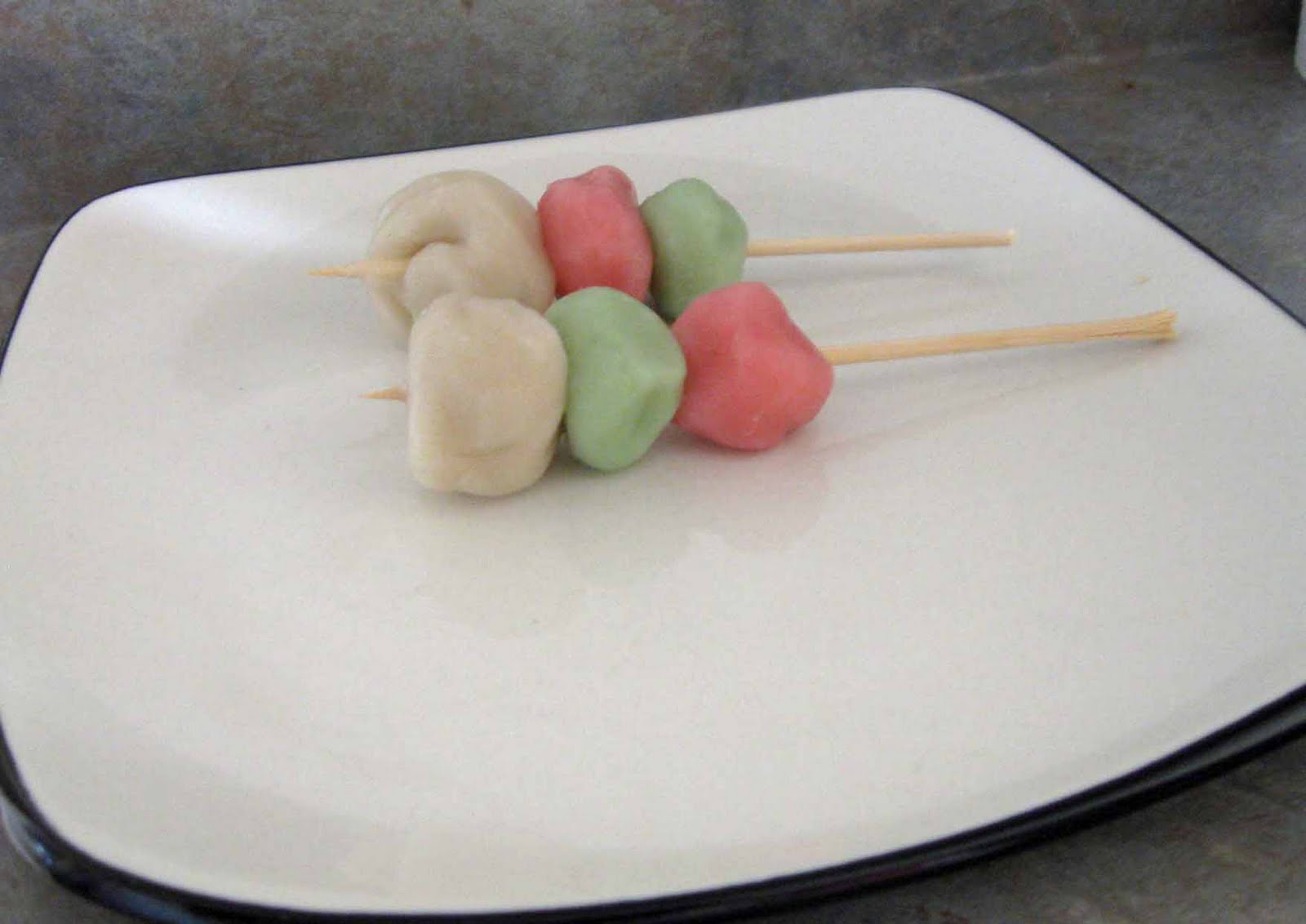
Other recipes we have tried are the Tonkatsu (fried pork cutlet), Oshinko (pickled vegetables), Sushi Rice,Tamapoyaki (Japanese omelets) and Yakitori (chicken kebabs). We especially enjoyed the Miso soup, which I think I’ll be making a regular, particularly in the winter. We also had fun making the sweet dumplings called 3-Color Dango. I ran into a small challenge with the mixture at first, as the recipe called for 1 1/3 cup of water to 2/3 cup of jyoshiko (rice flour) but that just made a soupy mess. Either I had the wrong type of flour or the recipe actually meant 1/3 cup of water. Anyway, I tried less water and it seemed to work. Once again I wasn’t sure how big to make the balls, so after making the white balls I decided to make the pink and green ones smaller. Dango is pretty to look at and strangely addictive to eat.
We are continuing to try the different recipes, as there are many more that we need to explore. I’m predicting that this year’s school lunches are going to be a lot more interesting.
Our family recommends this book; it’s a great way to try some simple new and tasty dishes and has proven to been a fun summer discovery.
The Manga Cookbook is presented by the Manga University Culinary Institute, recipes by Yoko Ishihara and illustrated by Chihiro Hattori, Published by Japanime Co. Ltd.


K-On Volume 1 by Kakifly

K-ON vol. 01
This is a manga I’ve heard buzz about online, and the large posters at the local anime shop got me thinking that I should see what the fuss is all about. K-On turned out to be a nice surprise. It’s isn’t hard-hitting or dramatic, it’s just a whole lot of fun.  
The first few pages are in colour which is immediately refreshing, just like with Chi’s Sweet Home. I admit that at first I was a little confused by the 4 panel layout, and it took me a little time to realize that the panels are to be read in a top down, left to right direction.
Synopsis: Two girls convince another two girls to join the Pop Music club in school in order to prevent it from being disbanded. Three of the girls are already familiar with instruments. Ritsu plays drums; Mio plays bass and Tsumugi’s on keyboard. The fourth member, Yui, agrees to play guitar although she has no experience. In the end they all decide to form a band. The pop club meets in the music room and they end up spending large amounts of time drinking tea and eating desserts thanks to Tsumugi who appears to be from an affluent family, and I have a feeling we will find out about who they are. Yui buys her first guitar and is so enamored with its beauty she is reluctant to play it. Eventually Yui does start learning to play, and in the process neglects her school work. The band needs to work together in order to to help get her grades up. Although the club now has enough members to remain valid, they discover that they are in need of a teacher-advisor before they can be official. The girls try to recruit the music teacher, Sawako Yamanaka, who turns them down.  Ritsu finds a photo album in the music room with a picture of the pop club members from years past and recognizes the music teacher who, despite her current “ladylike” teacher demeanour, was a hardcore rocker back in the day. They do some arm twisting and she agrees to become the advisor. The girls are now ready to prepare for their debut at the school festival leading them to deal with such issues as song writing, singing and costumes.  
Thoughts: The things I enjoyed about this manga, apart from the characters, was the little bits of detail Kakify put in, like how your fingers tips get really sore when you first start playing, and how callouses eventually form to help. I also enjoyed the part where Yui would just stare at her new instrument, polishing it and admiring it’s beauty. She even went so far as to sleep with it. As a one-time bass guitar player and band member, this was sort of a trip down memory lane (apart from all the tea and cakes). I feel a bit like the music teacher: I am now the serious mom who had a rockin’ past. I still have my guitar to prove it!
K-On by Kakify is published by Yen Press. Volume 3 is set to be released later this month.

Series Update: Fullmetal Alchemist 25, Bakuman₀ 5:

This month has seen the release of new volumes for series I follow, which is a lot of fun.  I've decided to use a slightly different approach to reviewing this time as I will be revisiting these series again and again. Instead of doing an in-depth synopsis I’m just going to relate a few thoughts about each volume and the series as a whole. It may not make a huge amount of sense if you are unfamiliar with the series, but these are more the “mainstream manga” so chances are you may have come across them. If you are a follower of any of them please feel free to tell me your thoughts about the latest volumes. I would love to start a conversation.
Fullmetal Alchemist Vol. 25: This series is quickly reaching its climax as the solar eclipse is on its way, the five sacrifices have been gathered and the grand plan is about to be revealed.   
Fullmetal Alchemist, Volume 25There is a lot I could say about this series, but I hate to give too much away. For those who haven’t already read this series it is one definitely worth checking out. Fullmetal Alchemist was my first manga series and will always have special place for me. This is an action-packed and fast-moving volume, with many pivotal moments. The most important has Alphonse (who incidentally is a currently a soul fused to an empty suit of armor) finally getting the opportunity to regain his body, but after seeing the state it’s in he must decide if he really wants it back.  In another important moment, the homunculus Greed appears to have divided loyalties, or perhaps Lin Yao is still able to control his body and suppress Greed. The most dramatic instant in the volume belongs to Colonel  Mustang, who has to make a very difficult decision as to whether he should bow down to demands and open the portal, using the forbidden human transmutation, in order to save someone he loves, or stay true to his principles. What Happens next to Mustang is quite shocking, but I will not say what because I wouldn’t want to ruin it for those who haven’t read or seen the anime yet.
Looking back over the series I would have to say that the character of Colonel Mustang stands out more and more as the series continues, so much so that in the end I think he has started to overshadow the Fullmetal Alchemist himself, Edward Elric, and puts him in a nice position for a series of his own. 
There are only a couple of more volumes of this series left, and it is sad to see it end. The journey has been  great so far.
Fullmetal Alchemist is by Hiromu Arakawa and is published by Viz Media. Vol 26 is to be released in September.  The series is rated T.
Bakuman, Volume 5Bakuman₀  Vol. 5:    Mashiro and Takagi finally got their wish to be serialized in Shonen Jump, and now the real work begins. But before they even get started they unexpectedly have to switch editors, shaking the boys’ confidence. Being serialized brings some perks, such as salary and assistants, but their responsibilities also grow. Deadlines loom and the challenge to remain good enough in the ratings to remain in Jump adds to the pressure.
This is still currently one of my favorites. It is one text-heavy manga, but I like that. Apart from it being about the manga business, I really enjoy the little scenarios that the characters experience that are very relate able. For instance, the scene where Mashiro is working with the three assistants for the first time and there is an awkward silence, I feel Mashiro's internal struggle as he tries to figure out how to fix the tension as he is now an employer and he feel responsible for the work atmosphere. Another scene I enjoyed was when the boys got to attend the company's  New Year party and experience their first taste of the adult world; I remember the weirdness I felt at my first corporate event. 
A great deal of consideration has gone into the character development, as I have a lot of “I know that guy” thoughts while reading. I know that there have been some complaints about some of the characters, especially the females, but from a writer's point of view, Tsugumi Ohba  uses some very interesting methods to create memorable characters, but that is a subject for another day.
Bakuman₀ Vol. 5 is by Tsugumi Ohba and Takeshi Obata and is published by Viz Media under Shonen Jump, rated T for Teen. Volume 6 is set for release in August 2011.

House of Five Leaves Volumes 1 & 2 by Natsume Ono

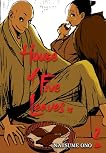
House of Five Leaves, Volume 1Synopsis (May contain spoilers) Volume 1: Akits Masanosuke (Masa) is a lone samurai. He has the stature of a samurai, but his inexperience, shyness and overall lack of confidence results in many failed attempts to find work as a bodyguard. One day, he comes across a man named Yaichi who takes an interest and offers him work. Drawn by Yaichi’s charm Masa agrees, and before he realizes, he unknowingly takes part in a crime. This is his introduction of the “Five Leaves,” the gang in which Yaichi leads.
Masa’s conscience weights heavily. He is troubled by the gang’s criminal activities, but is in desperate need of money and friendship. He is reluctant join the gang as a full member, yet his is unable walk away.

House of Five Leaves, Vol. 2In Volume 2, Masa continues trying to figure out what motivates Yaichi. Although Yaichi claims to be in it for the money, Masa suspects he may be some sort of “chivalrous thief”. Stricken by “Edo Disease”, Masa is sent to recuperate at the home of Goinkyo, an acquaintance of Five Leaf member Umezo. There, Masa learns more about the origins of the Five Leaves and begins to suspect that Yaichi is not who he says he is.
Thoughts:  Natsume Ono’s unique drawing style succeeds in creating an air of mystery. As the story unfolds it becomes more and more intriguing. Her panels have a certain quietness which helps generate the feeling that the characters are hiding things about themselves, and there is a general mistrust amongst the gang members. The story itself is complex and is the type of story that is difficult to predict where it's going, making the reader want to continue in order to find out. This is a similar method used by Natsume Ono in her previous book, “Not Simple”.
House of Five Leaves by Natsume Ono is published by Viz Media under the IKKI Comix/ Viz Signature labels. It is rated for older teens and the first three volumes have been released. Volume 4 set to be released in September 2011. The Anime version is available through Funimation.

Butlers, Bees, Bakuman and Lychee :

Last week I tried making a dent in my reading pile; this is what I read with a brief synopsis:


Black Butler, Vol. 5Black Butler Vol. 5: This one is all about the curry as Sebastian tries to concoct the winning recipe. There’s not much to this volume so it’s not one of my favorites. Since I missed reading Volume 4, perhaps it would have been more meaningful to me if I had read it. The first three volumes had a certain darkness to them that made them interesting, which seems to be missing in this latest issue. I love the artwork in this series,as stylistically it’s very interesting.

Black Butler is by Yana Toboso and is published by Yen Press rated for older teens.


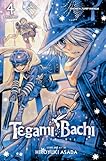
Tegami Bachi, Vol. 5Tegami Bachi : Letter Bee Volume 5: In this volume we get a little background of what motivates Zazie and why his amber  “resonates with his hatred”. We also learn about the tragic tale of Sarah and Hunt as well as the truth behind “the man who cannot be spirit” and its connection to Gauche’s disappearance. Speaking of Guache, he finally makes an appearance but he leaves as sea of tears in his wake.

This series is always emotionally intense, the whole series carries a feeling of misfortune, it's no wonder poor Lag Seeing is always in tears. I really like this series. Hiroyuki Asada crafts a world that really feels alive, and his artwork is so breathtakingly beautiful even the enemy Gaichuu shine like jewels. 

Tegami Bachi: Letter Bee is by Hiroyuki Asada published by Viz Media under the Shonen Jump label and is rated for teens.


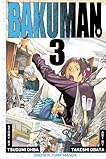
Bakuman, Vol. 4Bakuman 4: There is a riff between Moritaka Mashiro and Akito Takagi. Is it over for them? Anyway, even if they were still together, can two high school students possibly handle being in school and having a series in jump at the same time?  These questions and more are answered in this latest volume. Say what you will, but I always feel energised after reading this series.  I enjoy the writing, it’s full of suspense and strategising that seem to follow somewhat logical reasoning. This manga is heavy on the words but still manages to balance with the art work. This is the same formula that makes Death Note work so well. 

Bakuman is by Tsugumi Ohba and Tekeshi Obata and is published by Viz Media under the Shonen Jump label and is rated T for teens.


Lychee Light Club (The Lychee Light Club)Lychee Light Club: Well, where to start? This is probably the darkest manga I’ve read so far. I know it has been compared to Lord of the Flies but shamefully I haven’t read that, for some odd reason Rocky Horror Picture Show and Sweeny Todd popped into my mind (without the music of course).  The fact that this manga is an adaptation of a theatrical production Tokyo Grand Guignol’s Lychee Light Club, might explain the book’s theatrical feel.  There are several themes running through this story such as:  puberty and the fear of ageing, what it means to be human, how to define beauty, trust and betrayal and so much more. The difficult part about this manga is that it's ultra violent, highly sexualized and it is particularly nasty towards women. Having said that, the fact that this manga can generate so much discussion is a testament to its strength. 

There is a great review/discussion on the Lychee Light Club that can be found at the Manga Curmudgeon here.

Lychee Light Club is by Usamaru Furuya and is published by Vertical and is rated 18+ (strong warnings here).

The Sand Chronicles, Vols. 1-4 By Hinako Ashihara

Sand Chronicles, Volume 1This story follows Ann Uekusa and three friends: Shika, Fuji and Diago, who she met at the age of 12 in her mother’s rural home town of Shimane. This coming of age story is focused is on Ann, who struggles to come to terms with the loss of her mother and her reunification with her estranged father. Friendship becomes Ann’s anchor and soon develops into romance, and then into a long-distance relationship as she moves back to Tokyo with her father. By Volume Three, love triangles begin to emerge as the group is separated by distance.

Sand Chronicles, Volume 3The underlying theme throughout the series is the passage of time, symbolized by an hourglass. This began with Ann’s one happy childhood memory: a visit to the sand museum with her mother, where they saw a huge hourglass filled with sand that lasts a year. What struck Ann was how small the physical representation of a year looked. A souvenir hourglass she bought that day was broken the day her mother died, thus stopping time for her mother. A replacement hourglass bought by Ann’s boyfriend, Diago, is used symbolize Ann’s life moving forward. The changing seasons also feature in this series and help mark the passing years. 


A sweet and heart-breaking story, I look forward to reading the remaining volumes. I highly recommend checking it out.
The Sand Chronicles is by Hinako Ashihara and is published by Viz Media under the ShojoBeat label.  It is rated for older teens and there are ten volumes in the series.

Nura: Rise of the Yokai Clan Vols. 1 & 2

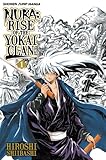
Nura: Rise of the Yokai Clan, Vol. 1The yokai are the monsters or demons that thrive in darkness and are feared by humans. Eight-year-old Rikuo Nura is split between the two worlds as he is one quarter yokai thanks to his grandfather, who also happens to be the Supreme Commander of Nura Clan. Because he grew up surrounded by yokai, he never saw them as evil and is surprised to learn that the other students at school loath and fear them. Just as Rikuo starts to suspect the yokai are malicious, he discovers that he is next in line to inherit the title of Supreme Commander, throwing him into emotional turmoil.  
May contain spoilers (although I try not to)
Volume 1: One day, when his school friends are in danger, Rikuo awakens to his yokai form and leads a rescue. Since he is only a quarter yokai, he cannot maintain this form for long and once again becomes human, throwing doubt on his suitability to be Supreme Commander. Four years pass. Rikuo has not transformed again and continues to live as a human deciding to reject his yokai heritage and keeping true identity secret from his friends at school. 
Sensing Rikuo’s reluctance to take command, other more dangerous yokai have started moving in on the Nura territory, putting humans in danger, forcing Rikuo to re-examine his decision. An incident within the yokai causes Rikuo to transform once again; this time he declares his intention to become the Third Supreme Commander. The only problem is that when he returns to his human form he has no recollection of anything his yokai self has done or said.
At school, Rikuo ironically finds himself to be a member of the Kiyojuji Paranormal Patrol, made up of fellow students and whose leader Kiyotsugu, wants to prove the existence of yokai.
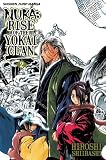
Nura: Rise of the Yokai Clan, Vol. 2Volume two:  Rikuo is transformed again to save his friends who were kidnapped by a rogue group of rat yokai. This time the transformation caused him to become ill, once again calling into question his viability as leader. Meanwhile the Kiyojuji Paranormal Patrol takes a spring break trip to Mt. Nejireme to meet with a yokai scholar. The trip turns out to be more than they bargained for and Rikuo's abilities are put to the test once more.
Conclusion: I enjoyed the first two volumes of this series. I like the concept of Rikuo Nura ‘s character being from two worlds,  which he handles in an almost Jekyll and Hyde way. At this point in the story it is difficult to predict which path he will follow, human or yokai. Perhaps he will succeed in integrating both. There a couple of other interesting characters to watch: one is Kana, the probable love interest, and the other is Yura Keikain who is a member of the Paranormal Patrol and happens to be an Onmyoji (an exorcist) who has the power to banish yokai. I will continue to follow this series to see how it progresses.
Just a quick note about the artwork: Hiroshi Shiibashi uses a brush rather than pen to ink and it produces a pleasant flowing effect making stand out from other mangas I’ve read.
Nura: Rise of the Yokai Clan is published by Viz Media under the Shonen Jump  label.  It’s rated for teens 13 plus.

Library Wars: Love & War Vol 1, 2 & 3

I was hesitant about reading this series; a library doesn’t seem to be likely grounds for a war. However I was pleasantly surprised.  The story is an adaptation of a novels series of the same name by Hiro Arikawa. It takes place in a world where a Media Betterment Act has given the government the power to limit the public’s access to media, including books. Under the Library Freedom Act, the library has become the only safe haven for books and has its own Library Defense Unit. The main character, Iku Kasahara, inspired by a childhood event, is determined to become a member of the Library Force to be able to stop the hunting of books as well as to meet the man who once rescued her, whom she refers to as her Prince. 


Warning may contain spoilers:
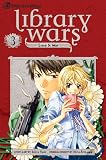
Library Wars: Love & War, Vol. 1In the first volume we see the formation of the Library Task Force Team Dojo, which in addition to Iku Kasahara,includes fellow student, perfectionist and high achiever Hikaru Tezuka, Assistant Team Captain Mikihisa Komaki and Team Captain Atsushi Dojo. Tension arises between the two students as Tezuka finds it hard to accept that Kasahara has been selected to be part of this elite group. However, the real focus of the story is their Instructor Dojo, who is handsome, strong and well respected in the force. He also happens to be several inches shorter than Kasahara. He is a difficult character to figure out, and at times he is unreasonably mean towards Kasahara, and other times he is encouraging and gentle.
Library Wars: Love & War, Vol. 2Volume Two sees Iku Kasahara involved in her fist assignment as a member of the Task Force as the library is raided by the Media Betterment Committee (MBC) and there is a possibility that they have inside help. A dangerous moment leads to Dojo coming to Kasahara’s rescue. The tensions within Team Dojo rise when Tezuka unexpectedly asks Kasahara to go out with him, causing her to question her goal of holding out for her Prince (the mystery man who rescued her when she was a child) or whether she has feelings for Dojo.
Library Wars: Love & War, Vol. 3 Volume Three has the friendship between Dojo and Kasahara slowly building but his pattern of acting mean towards Kasahara while secretly trying to protect her continues to confuse her. Meanwhile the tension between the Library and the MBC continue to escalate, leading to a standoff that puts everyone in real danger.


Final Thoughts: Two things make this series work: the hot/cold relationship between Iku Kasahara and her instructor Sergeant Atsushi Dojo, and the censorship war that rages in the background that raises interesting real world questions such as whether  books can incite violence in youth. I’m surprised to like this series as much as I do and I am waiting eagerly to get my hands on Volume 4, which has already been released.


Library Wars: Love & War is by Hiro Arikawa, illustrated by Kiiro Yumi published by Vizmedia under the Shojo Beat line.

Tokyopop and Other Observations

It has been an interesting week in the manga publishing world.  Friday saw the demise of the North American division of the publisher, Tokyopop. I came to be a fan of manga pretty late in the game so I missed experiencing Tokyopop in its heyday. I understand that they were largely responsible for introducing manga to North America and for keeping it in its current “flipped” format. I am grateful for that. 
The collapse of Tokyopop has brought to mind something I’ve noticed since January: there has been a dramatic reduction in the amount of manga available in the major books stores here in Canada; I have watched the Graphic Novel section shrink from a whole area of the store to a single shelf. Now that Tokyopop is out of the game I am afraid that the shelf space will shrink even further. New releases are becoming more difficult to find in stores; for instance, nowhere in this city is Blue Exorcist by Kazue Kato (VizMedia), available for purchase off the shelf. Thank goodness for online retailers, because soon that may be my only source to purchase manga in this city. 
This lack of visibility for manga and graphic novels makes it much more difficult for them to reach new audiences and that is tragic. I think that if more people tried them they would like them. There is still a general lack of understanding of what manga is, and I believe there must be a way to grow the readership to be wider than just teens and young adults. I see one untapped potential audience:  young mothers, who are too pressed for time to read long novels but still long for sources of escapism. Manga is a perfect fit because the books are a quick read with enough of an emotional impact to make the effort satisfying. They are portable, low tech and are perfect for filling the time while waiting for the kids to finish their various extracurricular activities.  
I want the industry to survive and I think that they need to start thinking outside the box to keep building audiences.That being said, I have a few Tokyopop mangas to read and review this week and do so, knowing the series will be discontinued.


You can see what others are saying about Tokyopop at the Manga Critic Here

Beauty Pop, Volumes 1 & 2

I guess it’s true when they say that there’s a manga for everything.  
Beauty Pop, Vol. 1Beauty Pop by Kiyoko Arai  published by Viz Media/ Shojo Beat, was one of that I picked up randomly while visiting the library.  
Plot Summary: This is an amusing story about a group of male students who call themselves the “Scissors Project”, who periodically choose a female student to makeover, allowing her to attract the guy of her dreams. The problem with the “SP” and their leader, hairstylist Narumi, is that only certain girls are deemed makeover worthy. That’s where first year student Kiri Koshiba comes in. She has a talent of her own and has been secretly transforming those rejected by the “Scissors Project” and it’s driving Narumi crazy. 
Review: The plot line is a little inconsequential; what drives this story is the characters. Shogo Narumi’s volatile personality and over confidence paired with Kiri Koshiba’s seeming aloofness and quiet confidence makes for an interesting dynamic. Volume One ended with enough of a cliff hanger to make me want to seek out next the next volume.
Beauty Pop, Vol. 2Vol. 2 adds a couple of new characters as well as some back-story. It also establishes the series’ overall goal: to form the beast beauty team in Japan. 
I was disappointed with the second volume. I felt that Narumi's character lost some of his strengths becoming over the top and the new character Iori Minamoto, was plain annoying (probably on purpose). Kiri Koshiba's character however, remained true and may succeed in carrying the series.The story is light and funny, and will appeal to a young audience. Beauty Pop by Kiyoko Arai is rated for teens 13+ and is published by Viz Media/Shojo Beat, ten volumes in all.

Blue Exorcist by Kazue Kato

Blue Exorcist, Volume 1
Out this month is Volume One of a new to North America series Blue Exorcist by Kazue Kato, published by Viz Media. It is also previewed in this month’s issue of Shonen Jump.
The story starts out pretty ordinarily: twin orphans are raised in a monastery by a Priest, Father Fujimoto, who is also an exorcist.  One twin, Yukio, is a gifted student studying to be a doctor. The other, Rin, is the opposite, a trouble maker and bad student. Yukio is enrolled in the prestigious True Cross Academy, while Rin reluctantly sets out to find a job. The story turns around when a dramatic event leads to Rin discovering his true identity: he is the son of Satan. Born to a human mother, Rin is the only twin to inherit demonic power. He learns that there are two realities, the one inhabited by humans called Assiah and the other is the realm of demons, Gehenna. Demons can only possess things in the human world but nothing exists that can contain Satan, that is, until the creation of Rin. He has become the perfect tool to enable Satan to lay claim to the human world. Refusing to accept this reality, he sets out to defeat Satan by training to become an Exorcist while trying to keep his inheritance hush-hush. Once in training Rin discovers Yukio has been keeping secrets of his own.
Despite the book’s slow beginning, the story becomes more and more fascinating, making it worth keeping an eye on.  I look forward to see what happens in next volume.
This story is rated T+ for older teens (16+).

Blood-C: Production I.G gets the CLAMP


Just got this rather brilliant news from my insider at Production I.G here in Tokyo: there's going to be another take on the Blood anime franchise.

According to the teaser press-release notes I received, Blood-C is a creative collaboration between Production I.G (the people behind anime classics Ghost in the Shell and the original Blood: The Last Vampire) and all-girl artist group CLAMP (they did the original manga of Tsubasa: Reservoir Chronicle and xxxHOLiC) - supervised by Junichi Fujisaku, one of the key people who developed the original concept for Blood: The Last Vampire (2000) and later directed the spin-off TV series Blood+ (2005).

This baby's slated as a TV series that'll be aired in Japan on MBS/TBS starting from July 2011 (see here), and also a theatrical feature film set for 2012.

The TV series will be directed by Tsutomu Mizushima, who helmed the xxxHOLiC - A Midsummer Night’s Dream feature film, based on CLAMP’s manga and also produced by Production I.G.

Anyway, enough cheating off the promotional notes. I'll let you know more when I do, but in the meantime I'm pretty darned excited about this.

I love my I.G.

This (below) was the trailer for the 2000 original.


IMAGE: © 2011 Production I.G, CLAMP / Project BLOOD-C TV

Can Graphic Novels Teach Us Something?

A trip to any preschool will show you that pictures are an important teaching tool.  Beyond the picture books, images are used to communicate everything from the steps to follow when washing hands to where to put things at the end of the school day. The universality of images can even help us as adults.  One of the most popular uses of sequential images for adults can be found in instruction manuals.  One company in particular, IKEA, uses images alone to communicate how to put together its furniture. 
However, the question is whether graphic novels can be used as teaching devices beyond instruction manuals and early childhood.
I found three books that do just that:

Making Comics: Storytelling Secrets of Comics, Manga and Graphic NovelsThe first is Making Comics by Scott McCloud, published by Harper. What better way to teach about how make comics than with a comic? Actually, this book, along with Scott McCloud’s previous books Understanding Comics and Reinventing Comics, really helped demystify comics for me. Although I grew up surrounded by comics I never really read them. Not until my own children showed interest in books such as Bone, Diary of a Wimpy Kid and Captain Underpants did I open my mind to comics and become interested in trying to understand what the attraction was. This book answered a lot of my questions and gave me a whole new respect for those who create comic books.

What It IsThe second book is What is? by Lynda Barry, published by Draw and Quarterly. In a semi-autobiographical way, Lynda Barry uses doodles and other images to explain how to re-gain the ability to imagine the way we once did as children. The book includes exercises that help us unlock the doors to creativity and avoid the perils of writers block. It serves as an inspiration to writers and artists everywhere.

The Adventures of Johnny BunkoFinally, the third book I looked at was by Daniel H. Pink who is best known for his bestselling books on the modern day workplace: A Whole New Mind, and Drive. In Johnny Bunko: The Last Career Guide You’ll Ever Need, Pink uses a manga format to explain the “most important lessons of a satisfying, successful career.” The story uses fictional characters, complete with a chopstick genie, to highlight the serious subject of choosing the right career path that will hopefully lead to long term happiness. This book is a quick read with an interesting message. It makes a great gift for students leaving high school, college or university and entering the workforce for the first time. Johnny Bunko is book is published by Penguin, artwork by Ten Pas.   

Uzumaki Vol. 1 by Junji Ito

Uzumaki, Volume 1Who knew that a simple shape could carry such a scary prophesy?  This is a genre of manga I hadn’t come across before: pure Horror. This book portrays a series of terrifying incidents experienced by seventeen-year-old Kirie Goshima and her reclusive boyfriend Shuichi, centered around the coastal town of KurĂ´zu-Cho. The spiral shape and its hypnotic quality lead people into wildly destructive obsessions. This is a well-drawn manga that succeeds in turning the normal into the sinister.  The cinematic quality of this book reminds me of horror movies I’ve seen in the past; "Creep Show” comes to mind. For those who love the horror this a definite read. This book is rated Older Teen because of disturbing images. It is published by Viz Signature.

Shonen Art Studio

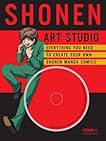
Shonen Art Studio: Everything You Need to Create Your Own Shonen Manga Comics  Wishing to make manga but lack artistic ability? Then Shonen Art Studio by Yishan Li published by Watson-Guptill Publications may be what you're looking for. This book includes a CD containing all sorts of character images, backgrounds, panel layouts, word bubbles and tones to use, allowing you to concentrate on writing the story. The book is a great introduction to the process of making manga digitally by giving readers hands on experience. However, in order to get the most out of this book it is necessary to have access to a computer, tablet, scanner, printer and some version of Photoshop (CS4 or Elements). Shonen Art Studio’s step by step instructions are easy to follow and give many useful tips such as how to turn a photograph into a background. I learned about digital coloring techniques such as cell shading which I tried out on one of my own drawings:


Although one can criticize this book for leading to the creation of generic comics, I think it can serve as starting point for novices who want to have fun making up stories and not worrying about drawing. Many of the same techniques can be applied to original artwork.

Tegami Bachi: Letter Bee by Hiroyuki Asada

Tegami Bachi: Letter Bee, Volume 1 Tegami Bachi, Volume 2: Letter Bee/The Letter to Jiggy Pepper Tegami Bachi, Vol. 3: Letter Bee Tegami Bachi, Vol. 4


Oh, the little Letter Bee.  I have to say that I love the artwork of this series.  Hiroyuki Asada creates a beautiful atmosphere in his world of perpetual darkness. This steampunk-style story follows the young Lag Seeing on his quest to first become a Letter Bee (a kind of postal worker) and then to find his friend and mentor Gauche Suede, a former Letter Bee who has mysteriously gone missing.  The ultimate goal is find his mother who has been kidnapped.  This is a series full of heart and plenty of tears but the tales within the stories are touching. 
The character names used in this series are very memorable.  At dinner I still can't resist the temptation to ask someone to pass the Jiggy Pepper and I will never look a Steak the same way. 
It is a sweet heart warming story about a boy who sees the best in everyone.  It is sprinkled with a humor and lots of action and mystery, enough make it appeal to both girls a boys and is good for ages 13+.
I am pleased to see that the anime closely follows the manga and brings Tegami Bachi to life in all its star filled darkness.
Volume 5  is to be released in May by Vizmedia/ Shonen Jump

Review: Barefoot Gen: A Cartoon Story of Hiroshima by Keiji Nakazawa Vol.1

Barefoot Gen, Volume One: A Cartoon Story of Hiroshima


This book is a fantastic example of the power of visual story telling.  It is an autobiographical account of the bombing of Hiroshima expressed through the eyes of seven year old Gen.  What is striking is Nakazawa’s vivid account of the horrors of war, showing us how terrible humans can be to one another. He also provides chilling look at the power of propaganda.  This book serves as both a reminder and a warning.  Prepare yourself: this is not light reading.


I recommend putting this book on the High School curriculum.  In school we had to read Hiroshima by John Hersey, also a powerful book; however, Barefoot Gen really gives the reader the sense of being there, deepening the understanding of this dark chapter in human history.  
I would rate this book a must read for teens 15+.  There a ten volumes in this series.
Thanks to Angela Eastman for bring this book to my attention.  You can check out her review : http://anglynn.wordpress.com/2011/02/17/mmf-barefoot-gen/


As always, I'm open to suggestions on books to check out.

Animal Academy: Hakobune Hakusho by Moyamu Fujino

Animal Academy: Hakobune Hakusho, Volume 1Animal Academy: Hakobune Hakusho, Volume 2

The setting of this story: a human has accidently enrolled in a school for animals masquerading as humans.  At first it seemed uncomfortably similar to Rosario+Vampire, Vol. 1 by Akihisa Ikeda  (which had monsters rather than humans), but this series is aimed at a younger audience.  Initially I was finding it difficult to understand the animals-wanting-to-be-human scenario, and by the end the first volume, apart from the super cute pictures, there were no compelling reasons to move to the next volume.  As I already had Volume 2 in my possession I kept reading.  Here the story started to redeem itself by adding some interesting characters and a little mystery to the mix.
Keeping in mind that this story is for a younger audience, I can see this appealing to girls aged 10+ who love animals, and it could make a good introduction to the manga genre. 

Why I Love Bakuman

Bakuman, Vol. 3

Unrelenting determination is the underlying theme of Bakuman, the latest series by the creators of Death Note, Tsugumi  Ohba and Takeshi Obata. The two main characters, Moritaka Mashiro and Akito Takagi, both aged 15, are determined to become successful Mangaka (Manga artists/writera) by having a regular series published in Shonen Jump and eventually having it made into an anime. 
The great thing about this story is to see how these teens are willing to do what it takes to make their dreams come true. They work hard, really hard, but at the same time they are willing to listen to the advice of others who have gone before them.
According to Malcolm Gladwell’s Outliers: The Story of Success, a person needs to put in 10,000 hours of work in order to become good at something.  Mashiro and Takagi are good example of this work ethic. As a parent, I would love see some of their resolve to rub off on my kids.    Many stories in North America tend to favour ‘instant success’ but this story gives a more realistic view of the hard work and ups and downs that go on behind the success (I am assuming they will be successful, but who knows).  Apart from the (clears throat) humour in this series, I would recommend it as good series for teens 13 and up.
An example of the infectious quality of the series, every time I read it I feel like I want to storyboard too. I’m looking forward to Bakuman Vol. 4 coming in out in April.


Alan Oldham Gets Beyond Djax


Back in the mid 1990s in Melbourne when I used to buy most of my vinyl from my mates at Octave Records, the stand-out 12-inches on the shelves were the ones by Djax-Up-Beats, the Dutch label run by Saskia Slegers (aka Miss Djax).

A stand-out not just because the music sitting pretty on this wax – sourced from the likes of Mike Dearborn, Steve Poindexter, K. Alexi Shelby, Claude Young and Thomas Heckmann – was sensational, but because the actual record labels on each one of those 12-inch releases were even more gorgeous. Turns out they’d been lovingly designed by another essential musical contributor from Detroit, Alan Oldham (DJ T-1000), and he even took up the time to draw up a few thumping action-based comics for Djax as well.

Seventeen years on Oldham is still making essential tunes and in fact has a brand new LP on the cards. Funnily enough it’s called the Beyond Djax LP, it will be coming out in March 2011, and in the promo notes it’s listed as the companion CD to last year’s sold-out art show in Amsterdam.

“I had a gallery show late last year, at a venue in Amsterdam that also sells limited-edition toys,” Oldham related in an email interview I did with him this week.

“I was in the middle of a tour, so I was present for the opening, and it was attended by such friends as Dave Clarke, DJ Bone, DJ Kammy, Ritzi Lee, Shinedoe and other friends and art lovers who came in from Dresden, Paris, Berlin, and London. It was a very successful show. Ben Sims bought two pieces right off the wall! I was in A’dam for a week, so I painted new pieces to replace the ones that sold, and they sold too. There were only two or three pieces left over at the end of the show, which lasted a month. The CD digipak will contain pics from the opening! There’s also a hardcover art book to go with the event.”

On the new LP, ‘Theme From Vectra’ is cited as a score for Oldham’s comic-book, Vectra: Black Girl From The Future. That comic, like much of the man’s artwork, has a clear nod in the direction of Japanese manga.

“Well I was into anime and manga years ago, before they were so available in the United States,” he says.

“Although we had Speed Racer when I was a kid, anime didn’t really make an impact with me stylistically until Macross came to America as Robotech. Then, I met a girl in college named Reiko, who gave me a few original manga from Japan, which I still have in storage. That really opened my eyes. I then changed my superhero-type art style to a manga-inspired one, and created Johnny Gambit. It was one of the first American manga published in the USA, along with Reggie Byers’ Shuriken and Doug Rice’s Dynamo Joe. Wow, that was long time ago – before I got into electronic music.”

The track ‘Theme From Vectra’ is futurist electronic tech stuff that somehow captures the essence of the speed, style and colour of the comic.

You can read more of this interview over on a new blog thingy I'm doing for the Elektrax label on electronic music; it's called Techno How? ...get it? ;)

Blog Archive