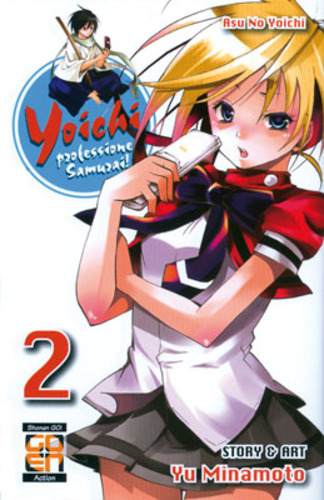
Riassunto: Inizia il nuovo semestre per i nostri protagonisti, e nuovo semestre vuol dire in questo caso nuovi personaggi. In particolare le tre (uniche) partecipanti al club scolastico di recitazione, il capo delle quali decide che Yoichi è l'uomo perfetto per lei e per il loro club e cerca di costringerlo a realizzare con loro una recita che possa riportare il club in auge. I metodi però non sono proprio quelli ortodossi e il samurai in un primo momento declina l'invito, per poi comunque accettarlo sotto i suggerimenti di Ibuki, che viene scelta come eroina. Ayame però non rimane a guardare e facendosi molta forza riesce a convincere la Fuchou a fare una sfida tra loro tre, nelle quali dovranno essere vestite come cameriere. La prima sorella e lo stesso boss del club si comportano in maniera ineccepibile, mentre Ayame fa la figura della 'maid imbranata' che però le fa conquistare con un grande successo il ruolo di eroina. Il volume si conclude con un capitolo che mostra le due sorelle in un doppio appuntamento con Washizu e Yoichi, ovviamente non avido di problemi (XD). In chiusura un carino e graditissimo extra sulla vita delle quattro sorelle prima che il samurai arrivasse al dojo.
Commento di Stormchaser: Lo spin-off finale mi è piaciuto davvero tanto, soprattutto vederle tutte e quattro in versione semichibi, erano davvero carine ^^ Interessanti poi i nuovi personaggi che dovremmo rivedere tutti nel prossimo volume, dato che questa recita non si è ancora vista e che comunque dovrebbe essere un evento importante all'interno del festival scolastico. Vediamo la prima volta un abbondanza assurda di "moe" quando Ayame si cimenta nel percorso vestita da cameriera con un bellissimo abito bianco (che le fa sembrare tutte e tre candidate spose di Yoichi), ma comunque anche se non mi piace molto, non risulta eccessivamente cattivo, anzi è inserito molto bene nella personalità della seconda sorella. Il resto diciamo che rimane un po' sottotono, con il doppio appuntamento che non mi ha detto molto, sembrava una ripetizione di quello nel terzo volume solo allargato. Sono comunque molto curioso di quel che vedremo lungo il percorso per realizzare questa recita :)
Commento di Akemichan: Volume corto per via dello spin-off, che però era molto carino. Tutta la storia della recita poteva risultare simpatica, ma non è che io abbia apprezzato particolarmente i personaggi che sono stati inseriti. L'unica che veramente mi piace molto è la seconda sorella, che anche in questo volume alla fine decide di impegnarsi per riuscire a conquistare Yoichi e alla fine riesce anche a ottenere il ruolo dell'eroina, è molto incoraggiante per tutte quelle che non sono super come Ibuki.
Riassunto: Inizia il nuovo semestre per i nostri protagonisti, e nuovo semestre vuol dire in questo caso nuovi personaggi. In particolare le tre (uniche) partecipanti al club scolastico di recitazione, il capo delle quali decide che Yoichi è l'uomo perfetto per lei e per il loro club e cerca di costringerlo a realizzare con loro una recita che possa riportare il club in auge. I metodi però non sono proprio quelli ortodossi e il samurai in un primo momento declina l'invito, per poi comunque accettarlo sotto i suggerimenti di Ibuki, che viene scelta come eroina. Ayame però non rimane a guardare e facendosi molta forza riesce a convincere la Fuchou a fare una sfida tra loro tre, nelle quali dovranno essere vestite come cameriere. La prima sorella e lo stesso boss del club si comportano in maniera ineccepibile, mentre Ayame fa la figura della 'maid imbranata' che però le fa conquistare con un grande successo il ruolo di eroina. Il volume si conclude con un capitolo che mostra le due sorelle in un doppio appuntamento con Washizu e Yoichi, ovviamente non avido di problemi (XD). In chiusura un carino e graditissimo extra sulla vita delle quattro sorelle prima che il samurai arrivasse al dojo.
Commento di Stormchaser: Lo spin-off finale mi è piaciuto davvero tanto, soprattutto vederle tutte e quattro in versione semichibi, erano davvero carine ^^ Interessanti poi i nuovi personaggi che dovremmo rivedere tutti nel prossimo volume, dato che questa recita non si è ancora vista e che comunque dovrebbe essere un evento importante all'interno del festival scolastico. Vediamo la prima volta un abbondanza assurda di "moe" quando Ayame si cimenta nel percorso vestita da cameriera con un bellissimo abito bianco (che le fa sembrare tutte e tre candidate spose di Yoichi), ma comunque anche se non mi piace molto, non risulta eccessivamente cattivo, anzi è inserito molto bene nella personalità della seconda sorella. Il resto diciamo che rimane un po' sottotono, con il doppio appuntamento che non mi ha detto molto, sembrava una ripetizione di quello nel terzo volume solo allargato. Sono comunque molto curioso di quel che vedremo lungo il percorso per realizzare questa recita :)
Commento di Akemichan: Volume corto per via dello spin-off, che però era molto carino. Tutta la storia della recita poteva risultare simpatica, ma non è che io abbia apprezzato particolarmente i personaggi che sono stati inseriti. L'unica che veramente mi piace molto è la seconda sorella, che anche in questo volume alla fine decide di impegnarsi per riuscire a conquistare Yoichi e alla fine riesce anche a ottenere il ruolo dell'eroina, è molto incoraggiante per tutte quelle che non sono super come Ibuki.
Riassunto: Il primo capitolo di questo quarto volume ci riporta ancora a stretto contatto con la terza sorella, Chihaya Ikaruga (e mia preferita tra le tre XD) e il suo grande talento nel disegnare manga e approfittare di qualsiasi situazione le si presenti. L'argomento però è di quelli un po' più seri che si presentano nel manga, infatti nella sua classe lei non è ben vista dato proprio il suo talento e dei suoi compagni non si fanno scrupoli a distruggere un quaderno con degli schizzi importanti, calpestando così i suoi sogni. Il samurai però sa quel che deve fare. Dopodichè vediamo ancora un po' di vita nel dojo, ma tutta incentrata sul personaggio di Washizu, che in questo capitolo cresce molto e realizza finalmente che avendo qualcosa da proteggere si diventa nettamente più forti e invincibili rispetto al suo 'status' solito, tutto grazie al samurai e ad Ayame, che suo malgrado si ritrova in una brutta situazione. Gli ultimi due capitoli sono dedicati ad un contrattacco di Sakon Saginomiya che riesce a far bere ad Ibuki una pozione che la fa regredire con la mente a quando aveva quattro anni. Tutto questo causa un enorme distacco tra lei e le altre tre sue sorelle, dato che si generano incomprensioni su incomprensioni. Sakon approfitta della situazione per cercare di far capire a tutte il dolore che sta provando lei visto che il fratello è sempre con la mente rivolta ad Ibuki, dopo la sconfitta dello scorso volume, ma anche in questa occasione tutti alla fine riescono ad appianare i malintesi e a tornare come prima.
Commento di Stormchaser: Forse uno dei volumetti di Yoichi professione Samurai che finora mi è piaciuto di più, specie perchè si trattano nei primi due capitoli due tematiche molto importanti: il rispetto degli altri e quale sia il concetto di 'vera forza' (visto anche in Tsubasa delle CLAMP tra Kurogane e Tomoyo), ovviamente rivisitato in chiave ecchi/comedy come il manga è, e come ci ha abituato :D Carini e divertenti anche i capitoli finali con il nuovo assalto dei Saginomiya, che penso rivedremo ancora in futuro dato che si inseriscono bene nella storia generale, specialmente con il povero Washizu che si comporta in maniera davvero comica con una Ibuki di 4 anni di fronte a lui, nel corpo della Ibuki che conosciamo però XD Molto bella quindi la lezione imparata dallo stesso Washizu quando la gang rivale da lui sconfitta riesce a rapire Ayame, ed insieme a Yoichi riesce a salvarla...quei due fanno una buona coppia di sparring quando ci si mettono! ;) Un po' triste il capitolo con Chihaya, ma pienamente comprensibile, che comunque riesce ad essere il più serio dei quattro presenti.
Commento di Akemichan: Volume carino. Mi è piaciuto molto la parte con Chihaya, insomma è un po' un cliché di lei perseguitata ma per il carattere che ci era stato mostrato finora mi è piaciuto parecchio vedere un'altra parte della sua natura, diciamo. Carina anche la seconda parte con Ibuki, anche se il finale mi sembrava un po' troppo buonista, ma ci stava. E comunque in generale è stato sia divertente (i pezzi con Washizu soprattutto) sia anche intenso per il rapporto che le quattro sorelle hanno fra di loro.
Riassunto: Il primo capitolo di questo quarto volume ci riporta ancora a stretto contatto con la terza sorella, Chihaya Ikaruga (e mia preferita tra le tre XD) e il suo grande talento nel disegnare manga e approfittare di qualsiasi situazione le si presenti. L'argomento però è di quelli un po' più seri che si presentano nel manga, infatti nella sua classe lei non è ben vista dato proprio il suo talento e dei suoi compagni non si fanno scrupoli a distruggere un quaderno con degli schizzi importanti, calpestando così i suoi sogni. Il samurai però sa quel che deve fare. Dopodichè vediamo ancora un po' di vita nel dojo, ma tutta incentrata sul personaggio di Washizu, che in questo capitolo cresce molto e realizza finalmente che avendo qualcosa da proteggere si diventa nettamente più forti e invincibili rispetto al suo 'status' solito, tutto grazie al samurai e ad Ayame, che suo malgrado si ritrova in una brutta situazione. Gli ultimi due capitoli sono dedicati ad un contrattacco di Sakon Saginomiya che riesce a far bere ad Ibuki una pozione che la fa regredire con la mente a quando aveva quattro anni. Tutto questo causa un enorme distacco tra lei e le altre tre sue sorelle, dato che si generano incomprensioni su incomprensioni. Sakon approfitta della situazione per cercare di far capire a tutte il dolore che sta provando lei visto che il fratello è sempre con la mente rivolta ad Ibuki, dopo la sconfitta dello scorso volume, ma anche in questa occasione tutti alla fine riescono ad appianare i malintesi e a tornare come prima.
Commento di Stormchaser: Forse uno dei volumetti di Yoichi professione Samurai che finora mi è piaciuto di più, specie perchè si trattano nei primi due capitoli due tematiche molto importanti: il rispetto degli altri e quale sia il concetto di 'vera forza' (visto anche in Tsubasa delle CLAMP tra Kurogane e Tomoyo), ovviamente rivisitato in chiave ecchi/comedy come il manga è, e come ci ha abituato :D Carini e divertenti anche i capitoli finali con il nuovo assalto dei Saginomiya, che penso rivedremo ancora in futuro dato che si inseriscono bene nella storia generale, specialmente con il povero Washizu che si comporta in maniera davvero comica con una Ibuki di 4 anni di fronte a lui, nel corpo della Ibuki che conosciamo però XD Molto bella quindi la lezione imparata dallo stesso Washizu quando la gang rivale da lui sconfitta riesce a rapire Ayame, ed insieme a Yoichi riesce a salvarla...quei due fanno una buona coppia di sparring quando ci si mettono! ;) Un po' triste il capitolo con Chihaya, ma pienamente comprensibile, che comunque riesce ad essere il più serio dei quattro presenti.
Commento di Akemichan: Volume carino. Mi è piaciuto molto la parte con Chihaya, insomma è un po' un cliché di lei perseguitata ma per il carattere che ci era stato mostrato finora mi è piaciuto parecchio vedere un'altra parte della sua natura, diciamo. Carina anche la seconda parte con Ibuki, anche se il finale mi sembrava un po' troppo buonista, ma ci stava. E comunque in generale è stato sia divertente (i pezzi con Washizu soprattutto) sia anche intenso per il rapporto che le quattro sorelle hanno fra di loro.
Riassunto: Yoichi, Ibuki e tutte le persone del dojo sono andate in vacanza al mare invitando anche Tsubasa ed Angie e gli allievi del dojo stesso. Si susseguono situazioni incasinate su situazioni incasinate con il samurai sempre protagonista involontario (seguite poi da pestaggi molto volontari XD). Ci concentriamo maggiormente su Kagome, che ha un problema che sta nascondendo a tutti i presenti e grazie al samurai stesso riuscirà (più o meno) a superare il suo disagio. Segue un violento combattimento con i fratelli Saginomiya, che li avevano attirati sull'isola con l'inganno dato che il maggiore era stato sempre innamorato di Ibuki, ma Yoichi grazie al suo grande allenamento riesce a superare la prova e la vacanza può concludersi senza grossi problemi. L'ultimo capitolo è il tradizionale delle sagre di città, con le ragazze in yukata eleganti e una presa di posizione decisa -ma sofferta- da parte della seconda sorella, Ayame, nei confronti del samurai Yoichi.
Commento di Stormchaser: Come sempre situazioni divertenti dopo situazioni divertenti XD Questa volta poi la combo tripla Ayame/Tsubasa/Ibuki è stata particolarmente devastante per il nostro eroe samurai :D Mi ha fatto ridere tantissimo la scena di quando tutti quanti riescono a nuotare e Yoichi se ne esce con un divertentissimo "Ibuki, blob, blob, blob!" Ah ah XD Il combattimento contro gli emissari dei Saginomiya comunque è il catalizzatore delle attenzioni di questo volume, dato che il samurai da una delle sue migliori prestazioni viste finora nel contrastare tutti i numerosi avversari che gli si parano davanti. Il capitolo della fiera è, come in tutta questa tipologia di manga dove viene inserito, sempre molto bello e carino a vedersi, e le ragazze in yukata fanno sempre il loro grande effetto ^^ Molto contento per Ayame che finalmente riesce a farsi avanti con Yoichi, anche se ancora si capisce se l'autrice vorrà effettivamente creare una coppia tra il samurai e qualcuna delle ragazze finora incontrate, Ibuki ed Ayame su tutte :)
Commento di Akemichan: Capitolo che mi è piaciuto a metà. Ho apprezzato molto tutta la storia di Ayame, lei mi piace molto come carattere e soprattutto la sua storia d'amore è dolce e realistica, la apprezzo molto. Invece non mi è piaciuta l'idea della bambina maggiorata, francamente mi fa anche un po' impressione, e anche i due fratelli Saginomiya non mi hanno ispirato granché come personaggi, mi sono sembrati stupidi e basta.
Riassunto: Yoichi, Ibuki e tutte le persone del dojo sono andate in vacanza al mare invitando anche Tsubasa ed Angie e gli allievi del dojo stesso. Si susseguono situazioni incasinate su situazioni incasinate con il samurai sempre protagonista involontario (seguite poi da pestaggi molto volontari XD). Ci concentriamo maggiormente su Kagome, che ha un problema che sta nascondendo a tutti i presenti e grazie al samurai stesso riuscirà (più o meno) a superare il suo disagio. Segue un violento combattimento con i fratelli Saginomiya, che li avevano attirati sull'isola con l'inganno dato che il maggiore era stato sempre innamorato di Ibuki, ma Yoichi grazie al suo grande allenamento riesce a superare la prova e la vacanza può concludersi senza grossi problemi. L'ultimo capitolo è il tradizionale delle sagre di città, con le ragazze in yukata eleganti e una presa di posizione decisa -ma sofferta- da parte della seconda sorella, Ayame, nei confronti del samurai Yoichi.
Commento di Stormchaser: Come sempre situazioni divertenti dopo situazioni divertenti XD Questa volta poi la combo tripla Ayame/Tsubasa/Ibuki è stata particolarmente devastante per il nostro eroe samurai :D Mi ha fatto ridere tantissimo la scena di quando tutti quanti riescono a nuotare e Yoichi se ne esce con un divertentissimo "Ibuki, blob, blob, blob!" Ah ah XD Il combattimento contro gli emissari dei Saginomiya comunque è il catalizzatore delle attenzioni di questo volume, dato che il samurai da una delle sue migliori prestazioni viste finora nel contrastare tutti i numerosi avversari che gli si parano davanti. Il capitolo della fiera è, come in tutta questa tipologia di manga dove viene inserito, sempre molto bello e carino a vedersi, e le ragazze in yukata fanno sempre il loro grande effetto ^^ Molto contento per Ayame che finalmente riesce a farsi avanti con Yoichi, anche se ancora si capisce se l'autrice vorrà effettivamente creare una coppia tra il samurai e qualcuna delle ragazze finora incontrate, Ibuki ed Ayame su tutte :)
Commento di Akemichan: Capitolo che mi è piaciuto a metà. Ho apprezzato molto tutta la storia di Ayame, lei mi piace molto come carattere e soprattutto la sua storia d'amore è dolce e realistica, la apprezzo molto. Invece non mi è piaciuta l'idea della bambina maggiorata, francamente mi fa anche un po' impressione, e anche i due fratelli Saginomiya non mi hanno ispirato granché come personaggi, mi sono sembrati stupidi e basta.
Riassunto: Facciamo la conoscenza di due nuove protagoniste nella storia del manga, ovvero Tsubame Tsubasa ed Angela (Angie) Tatatksukasa. Queste due ragazze sono venute a quanto pare in ricerca di Yoichi, per sconfiggere lui e la sua scuola di samurai, così da far modo che il loro mandante riesca a risollevare la loro propria scuola. Il 'primo contatto' avviene al liceo frequentato dal samurai con Tsubasa che però diventa sua amica invece di attaccarlo e sconfiggerlo. Allora Angela decide di occuparsi personalmente della situazione, ma con pochi e scarsi risultati dato che il samurai è stato così ben addestrato che riesce tranquillamente a difendersi ed anche attaccare nel sonno, riusceno a rendere inerme l'avversaria. In chiusura un divertente capitolo che mostra Yoichi alle prese con il mondo moderno unito agli appuntamenti con le ragazze, cosa del quale lui è totalmente inesperto. Ibuki gli propone una uscita di prova per 'educarlo' al giusto comportamento, che poi si rivela coinvolgerla a tal punto che si rende conto (molto velatamente) di provare forse qualcosa per il samurai stesso.
Commento di Stormchaser: Volume carino anche questo, per la storia del samurai nella città moderna. Mi è piaciuto davvero tanto proprio il capitolo finale. Vedere i due impegnati in un appuntamento è stato qualcosa di molto suggestivo, soprattutto per il pensiero che lui ha avuto nei confronti di Ibuki, che ne è rimasta nettamente sorpresa. Il resto invece non è da meno comunque, visto che lo scontro con Angela è stato davvero spassoso (specie la spiegazione di quando lui era ancora con il padre) e la poverina da attaccante fiera si è ritrovata attaccata distrutta, viste le mosse 'sapienti' del samurai XD Ma anche il combattimento iniziale, in pienissima chiave ecchi, non è stato per nulla male, con la solita mossa che colpendo la guardiana di Tsubasa solo di striscio la fa rimanere mezza nuda, esponendo il povero samurai ancora e ancora ai pestaggi della furiosa Ibuki! XD La storia ora inizia a districarsi rispetto allo scorso volumetto, e nei prossimi avremo ancora avversari e ancora lezioni da 'via del samurai' da leggere penso.
Commento di Akemichan: Capitolo carino, soprattutto la parte col l'appuntamento tra Ibuki e Yoichi (ma povero però, che è stato fregato, s'era impegnato davvero per fare bella figura all'appuntamento!), molto dolce ma anche divertente, anche se naturalmente sembra che Ibuki stia iniziando a provare qualcosa per lui... Comunque mi ha fatto piacere vedere che si sta un po' più distanziando da Love Hina, in questo secondo volume. Molto carino anche il personaggio di Tsubasa, il suo 'segreto' m'ha fatto morire XD Mi è piaciuto che ci siano stati di nuovo dei combattimenti, rende il tutto un po' più interessante.
Riassunto: Facciamo la conoscenza di due nuove protagoniste nella storia del manga, ovvero Tsubame Tsubasa ed Angela (Angie) Tatatksukasa. Queste due ragazze sono venute a quanto pare in ricerca di Yoichi, per sconfiggere lui e la sua scuola di samurai, così da far modo che il loro mandante riesca a risollevare la loro propria scuola. Il 'primo contatto' avviene al liceo frequentato dal samurai con Tsubasa che però diventa sua amica invece di attaccarlo e sconfiggerlo. Allora Angela decide di occuparsi personalmente della situazione, ma con pochi e scarsi risultati dato che il samurai è stato così ben addestrato che riesce tranquillamente a difendersi ed anche attaccare nel sonno, riusceno a rendere inerme l'avversaria. In chiusura un divertente capitolo che mostra Yoichi alle prese con il mondo moderno unito agli appuntamenti con le ragazze, cosa del quale lui è totalmente inesperto. Ibuki gli propone una uscita di prova per 'educarlo' al giusto comportamento, che poi si rivela coinvolgerla a tal punto che si rende conto (molto velatamente) di provare forse qualcosa per il samurai stesso.
Commento di Stormchaser: Volume carino anche questo, per la storia del samurai nella città moderna. Mi è piaciuto davvero tanto proprio il capitolo finale. Vedere i due impegnati in un appuntamento è stato qualcosa di molto suggestivo, soprattutto per il pensiero che lui ha avuto nei confronti di Ibuki, che ne è rimasta nettamente sorpresa. Il resto invece non è da meno comunque, visto che lo scontro con Angela è stato davvero spassoso (specie la spiegazione di quando lui era ancora con il padre) e la poverina da attaccante fiera si è ritrovata attaccata distrutta, viste le mosse 'sapienti' del samurai XD Ma anche il combattimento iniziale, in pienissima chiave ecchi, non è stato per nulla male, con la solita mossa che colpendo la guardiana di Tsubasa solo di striscio la fa rimanere mezza nuda, esponendo il povero samurai ancora e ancora ai pestaggi della furiosa Ibuki! XD La storia ora inizia a districarsi rispetto allo scorso volumetto, e nei prossimi avremo ancora avversari e ancora lezioni da 'via del samurai' da leggere penso.
Commento di Akemichan: Capitolo carino, soprattutto la parte col l'appuntamento tra Ibuki e Yoichi (ma povero però, che è stato fregato, s'era impegnato davvero per fare bella figura all'appuntamento!), molto dolce ma anche divertente, anche se naturalmente sembra che Ibuki stia iniziando a provare qualcosa per lui... Comunque mi ha fatto piacere vedere che si sta un po' più distanziando da Love Hina, in questo secondo volume. Molto carino anche il personaggio di Tsubasa, il suo 'segreto' m'ha fatto morire XD Mi è piaciuto che ci siano stati di nuovo dei combattimenti, rende il tutto un po' più interessante.
Riassunto: Yoichi è un samurai nel mondo moderno, che viene mandato dal padre ad incrementare le sue conoscenze nel dojo di una famiglia amica in città. Il problema principale per il ragazzo, esclusa la sua inesperienza totale con la vita cittadina, sarà che il dojo stesso è gestito da una ragazza della sua età, che ha altre tre sorelle! Una volta fatta la conoscenza delle quattro, ognuna con un carattere e personalità completamente diverso dalle altre, vediamo Yoichi affrontare i primi problemi della vita scolastica, con il teppista Washizu che lo sfida a duello a causa del suo attaccamento ad Ibuki, la prima sorella. Nel terzo capitolo vediamo Chihaya circuire alla grande il ragazzo (XD), mettendolo alla prova sul piano 'approfittarsi delle donne', cosa che porta ad altri dolorosi equivoci e pestaggi per lui da parte della stessa Ibuki. Nell'ultimo facciamo la conoscenza della seconda sorella, Ayame, che è contrastata dalla spinta emotiva di aiutare il samurai ammalato e il suo carattere pienamente tsundere.
Commento di Stormchaser: Un manga davvero molto divertente, anche nella sua componente principale, ovvero la categoria ecchi degli eventi che accadono ;) Biancheria intima, vestiti che si strappano, mani che toccano dove non dovrebbero, per poi avere conseguenze pesanti XD sono la regola in questo come in altri del genere (Ai Kora, Love Hina, Negima). Ma questo ha un surplus che me lo ha fatto piacere subito, e mi ha convinto a comprare il volumetto, ovvero che tutte le 'sfide' affrontate dal protagonista Yoichi vengono rivisitate in chiave di 'insegnamenti samurai'. Questo fa si che anche la cosa più banale acquisisca importanza di fronte alla 'via del samurai' che lui ed Ibuki seguono. Tra le quattro sorelle è il carattere di Chihaya a piacermi maggiormente, che mi ricorda quello di Haruna in Negima, furba e spietata ma anche decisa e volenterosa :) In chiusura divertenti gli extra alla fine dello stesso volume, con una intervista alle quattro sorelle XD
Commento di Akemichan: sinceramente, come primo volume non mi ha entusiasmato per niente. I personaggi sono carini, il disegno anche, ma mi è sembrato tutto, troppo identico a Love Hina. Va bene che siamo in un genere harem/ecchi e purtroppo non ci si può aspettare un granché di originalità, ma il primo capitolo sembrava praticamente identico, sul serio, le stesse identiche scene che praticamente capitano a Keitaro quando entra nel dormitorio per la prima volta. Le uniche note di merito sono Ayame, che mi è sembrato un personaggio realistico nella sua rivalità con la sorella maggiore Ibuki, e che almeno rende la trama un po' meno scontata; e il personaggio principale Yoichi che alla fine si distacca (per fortuna) da quello di Keitaro e risulta tutto sommato simpatico.
Riassunto: Yoichi è un samurai nel mondo moderno, che viene mandato dal padre ad incrementare le sue conoscenze nel dojo di una famiglia amica in città. Il problema principale per il ragazzo, esclusa la sua inesperienza totale con la vita cittadina, sarà che il dojo stesso è gestito da una ragazza della sua età, che ha altre tre sorelle! Una volta fatta la conoscenza delle quattro, ognuna con un carattere e personalità completamente diverso dalle altre, vediamo Yoichi affrontare i primi problemi della vita scolastica, con il teppista Washizu che lo sfida a duello a causa del suo attaccamento ad Ibuki, la prima sorella. Nel terzo capitolo vediamo Chihaya circuire alla grande il ragazzo (XD), mettendolo alla prova sul piano 'approfittarsi delle donne', cosa che porta ad altri dolorosi equivoci e pestaggi per lui da parte della stessa Ibuki. Nell'ultimo facciamo la conoscenza della seconda sorella, Ayame, che è contrastata dalla spinta emotiva di aiutare il samurai ammalato e il suo carattere pienamente tsundere.
Commento di Stormchaser: Un manga davvero molto divertente, anche nella sua componente principale, ovvero la categoria ecchi degli eventi che accadono ;) Biancheria intima, vestiti che si strappano, mani che toccano dove non dovrebbero, per poi avere conseguenze pesanti XD sono la regola in questo come in altri del genere (Ai Kora, Love Hina, Negima). Ma questo ha un surplus che me lo ha fatto piacere subito, e mi ha convinto a comprare il volumetto, ovvero che tutte le 'sfide' affrontate dal protagonista Yoichi vengono rivisitate in chiave di 'insegnamenti samurai'. Questo fa si che anche la cosa più banale acquisisca importanza di fronte alla 'via del samurai' che lui ed Ibuki seguono. Tra le quattro sorelle è il carattere di Chihaya a piacermi maggiormente, che mi ricorda quello di Haruna in Negima, furba e spietata ma anche decisa e volenterosa :) In chiusura divertenti gli extra alla fine dello stesso volume, con una intervista alle quattro sorelle XD
Commento di Akemichan: sinceramente, come primo volume non mi ha entusiasmato per niente. I personaggi sono carini, il disegno anche, ma mi è sembrato tutto, troppo identico a Love Hina. Va bene che siamo in un genere harem/ecchi e purtroppo non ci si può aspettare un granché di originalità, ma il primo capitolo sembrava praticamente identico, sul serio, le stesse identiche scene che praticamente capitano a Keitaro quando entra nel dormitorio per la prima volta. Le uniche note di merito sono Ayame, che mi è sembrato un personaggio realistico nella sua rivalità con la sorella maggiore Ibuki, e che almeno rende la trama un po' meno scontata; e il personaggio principale Yoichi che alla fine si distacca (per fortuna) da quello di Keitaro e risulta tutto sommato simpatico.
If the image (left) doesn't grab you straight away, take my word for it - as cheap as it sometimes is.
This was was an interesting series. I always love my Production I.G stuff, and it's great to see it getting the attention it deserves outside Japan.
The complete first season was released overseas towards the end of last year by FUNimation Entertainment in the USA, and it's also out through my fave chaps at Madman in Australia.
I did an interview with the series' character designer and chief animation director, Toku Okubo, back in 2009 for the late Geek Monthly magazine, and it went something like this (well, actually, a lot like this since I just cut and pasted):
Sans Wikipedia, you’d be forgiven for not immediately guessing when the Sengoku Period took place.
So let’s indulge in a quickie history lesson here.
Also known as the Warring States era, the Sengoku Period covers a time of dramatic political and military flip-flop that gripped then-divided Japan, from the middle of the 15th century to the beginning of the 17th, when shogun Tokugawa Ieyasu took charge.
Think something akin to the barbarity of Europe’s Thirty Years’ War (1618-1648), minus the religious hogwash but with occasional earthquakes added into the mix, and you may begin to get an accurate picture.
357 years, two months and six days after the peace treaty that ended the European equivalent of complete chaos (in other words, on July 21, 2005, just to save you wearing down your fingers), Japanese videogame producer Capcom - the makers of similarly rough-and-tumble games like Street Fighter, Captain Commando and Resident Evil - released Sengoku Basara (戦国BASARA, aka Devil Kings) for PlayStation 2.
Obviously the game’s specifics revolved around the mayhem of the Warring States period, and it starred three real-life historical warlords as the central cast: Sanada Yukimura (once dubbed the #1 warrior in Japan), Date Masamune (nicknamed the One-Eyed Dragon, for obvious reasons.), Takeda Shingen (the Tiger of Kai), and Oda Nobunaga (the Devil King himself), a man who conquered much of Japan before committing seppuku in 1582.
Given the ever-popular combination of the slice-and-dice action format with samurai iconography (it sold 1.2 million units in Japan alone), this baby was always destined to reach screens other than PCs, and play on machines dedicated away from games - which is where veteran anime studio Production I.G (of Ghost in the Shell franchise fame) became involved.
Their resultant series, released on TVs here in Japan from April [2009], is not directly based on dusty facts from antiquity, but sets its sights on “paying homage to history” - which gives them plenty of leeway to be creative, especially in the character stakes.
Think contemporary brooding flair and surly, somewhat streetwise youth-culture antics that rest at home in the 21st century living room, rather than the blank, honor-bound rural rigidity probably present four centuries ago.
“It also has a high-octane story arc and fantastic action throughout the whole series,” assesses character designer and chief animation director, Toku Okubo. “I think we’ve created a whole new genre that didn’t exist before!”
While this is Okubo’s first major foray into character design, he previously worked on key animation on Mamoru Oshii’s Ghost in the Shell 2: Innocence, as well as on the Ghost in the Shell TV series and Immortal Grand Prix, and was the animation director on several episodes of Blood+.
Also on board for the I.G ride is director Itsuro Kawasaki, who helmed the Tsubasa Reservoir Chronicle movie and did episode directing chores on Ghost in the Shell and Noir on TV. Scripting the armoured descent into anarchy is Yasuyuki Muto, responsible for the movie Afro Samurai: Resurrection, costume romp Le Chevalier D’Eon, and ninja-actioner Basilisk.
Okubo’s own involvement, however, had quite unusual origins.
“Everything started when the producer, Tetsuya Nakatake, held an in-house competition to establish the character designer for this new series. I‘d worked as a key animator many times, but never designed the characters for any project thus far. I thought this was going to be a good opportunity, and I took on the challenge.”
Luckily for us he was successful, as the character designs here are sensational - although Okubo is keen to pass around the plaudits.
“Each artist added his personal touch in creating the spectacular animation for each character’s fighting technique,” he raves.
“And the background art is beautiful. It perfectly matches with the colour palette used for the characters, and this gives a distinctive realism to the animation as a whole.”
The action here is as vital as the rapidly changing story and the range of unique characters involved, and Okubo is quick to make his pick of the cream of the crop of historical figures at play in the series.
“Takeda Shingen,” he blurts out. “He’s a real dandy, and he can fill the screen by just being there.”
With Okubo himself doing all the cast compositions, Shingen most certainly does - it helps when your own design god goes to bat for you.
Here's the opening montage to the series; you'll have to pick up and watch the rest:
You may never have heard of Hōjō Soun, and that's because in war the winners have the bragging rights.
Hōjō Soun was a conspicuous warlord during the Sengoku warring period in the south Kanto region and there's even a statue of the chappie in front of Odawara JR Station.
He's also attributed with the telling aside, "A man shows his inmost self by a single word".
This erstwhile leader (really named Ise Shinkuro Nagauji - he became a monk and adopted the name of 'Soun') had humble beginnings, with apparently just six men under his command in 1480; his success was such that by the time of his great-great-grandson in 1590 the clan possessed tens of thousands of them.
In 1493 Soun gained control of Izu province and the following year he secured what would be the Hōjō Clan's future capital: Odawara.
Word is that in order to do so he arranged for the young lord of the castle to be (ahem) murdered while he was out hunting.
In 1512 the ancient capital of Kamakura was added to the Hōjō territories, followed by Arai in 1518.
It was around this time that Soun took on the ancient aristocratic name of Hōjō in order to associate his new and powerful family in this part of Japan with that of the shikken who ruled for 150 years. The new Hōjō family (also known as the Odawara Hōjō) took on the Kamakura Hōjō's mon, or badge.
There's even a t-shirt you can get online with their family crest here at Zazzle.
Hōjō Soun died at the impressive age of 88 but the clan he set up wasn't so lucky.
While their power in the Kantō region in the 16th century grew to rival that of the Tokugawa clan, but eventually they were eliminated by Toyotomi Hideyoshi after the long Siege of Odawara (May to August 1590).
Before Odawara fell, however, Hideyoshi's forces laid siege to the unfinished Hachiōji-jō, the castle of Hōjō Ujiteru, brother of clan leader Hōjō Ujimasa.
After he left his own fortress to assist his older brother at Odawara Castle, Ujiteru's keep was left undermanned. While considered unassailable in its position astride Mount Fukazawa, only around 1,300 soldiers were there to defend when 50,000 or more of Hideyoshi's troops arrived; legend has it that families threw themselves into the nearby waterfall and that the waters of the river ran red with blood.
The castle fell in just over a day and was later destroyed by the victorious forces.
As a tourist spot, Shiroyama (as the site is now called), despite being a short bus ride from JR Takao Station, has been pretty much overshadowed by the crazily popular nearby Mount Takao.
That's the joy of the place.
It's a huge national forest that has easy hiking trails and castle ruins, and that infamous waterfall is still there - beside the beaten-down ramparts. The Hachiōji Castle site is in fact one of the hidden gems of Japan, as the pictures here may (or may not) attest.
And it's a beautiful place that's eerily empty.
Possibly this is because of the rumour that the place is haunted keeps some people at bay, or equally it's the ignominious fate of the original owners.
So what did happen to them, anyway?
As I mentioned, the losers rarely write the history. After the Hōjō were defeated in the siege of Odawara, Ujiteru was forced to commit seppuku along with his brother Ujimasa.
But Ujimasa himself still lives on, however, in the video game Sengoku Musou 3 (Samurai Warriors 3), released in Japan for the Wii in December 2009.
Quite bizarrely the Hōjō Clan bigwig's weapon is a cane that has a sword hidden inside, which can also fire bullets.
The Siege of Odawara is the climax of Hideyoshi's story in the earlier game Samurai Warriors 2, while Shuranosuke Sakaki is a long-running manga character and had his onscreen debut in the rather sub-standard 1990 animation Sword for Truth by anime director Dezaki Osamu, which tells of the struggles of the defeated members of the Hōjō Clan to save face by obtaining two mythical swords - and they contract the bad-ass master swordsman Shuranosuke Sakaki to do so.
Shuranosuke Sakaki and the ragtag fleet of Hōjō survivors also pop up in the 1996 live-actioner Legend of the Devil, directed by Masaru Tsushima (Ninja Women) and starring Masaki Kyômoto (Legend of Eight Samurai).
So there is some life after death after all, even for the also-rans.
1984 might’ve been the year that the Macintosh was introduced, Terms of Endearment won the Oscar for Best Picture, and Australia swapped national anthems (finally ditching ‘God Save the Queen’), but it was also the year that a major Japanese magazine conducted a national poll; when the results were in the actor Toshiro Mifune, at age 64, was declared the winner of the ‘Most-Japanese Man’ competition – singled out from all Japanese males, past and present, over the nation’s known history.
This is no minor feat when you fathom that the Japanese trace their recorded history back two millennia.
Mifune was prolific in the acting industry long before attempting English language roles in Steven Spielberg’s 1941 or the TV miniseries Shogun.
His filmography at imdb.com tips the 180 mark, over a hundred of which were produced prior to his turn as Lee Marvin’s violent Man Friday in Hell in the Pacific (1968); the list stretches from his first film in 1947 through to the his death at age 77, fifty years later.
It’s no accident that Akira Kurosawa, the writer/director with whom Mifune did his superior work, orchestrated most of these Japanese films. By the time the rest of the world cottoned on to the actor, he and Kurosawa were estranged, having made their last film together in 1965 after a partnership that lasted almost two decades.
There’s his well-meaning rookie cop, eerily akin to a young Gregory Peck, who loses his gun on public transport in Stray Dog(1949); the brash samurai charlatan in Seven Samurai (1954); his hyperactive, paranoid dynamo in the Macbeth-as-jidaigeki-drama, Throne of Blood (1957); a bespectacled salaryman with the slow-burning vendetta in The Bad Sleep Well (1960); the ailing yakuza gangster in Drunken Angel in 1948.
Over the 98-minute course of Drunken Angel (this is one of Kurosawa’s shorter tales) the actor is by turns brutal and suave; at other moments there’s a scary vitality to his agitated, hollowed out face-of-impending-doom performance – in particular the show-stopping manic turn he makes in a drunken dance hall.
While the film stock may have dated, the style and performance here most certainly hasn’t.
Perhaps the most memorable and famous of Mifune's roles is the blasé, mysterious stranger in Yojimbo (1961) and its sequel Sanjuro the following year – himself the role model for both Clint Eastwood’s and Bruce Willis’ Man with No Name characters in A Fistful of Dollars and Last Man Standing.
The stand-out collaboration is debatable, but if you want to angle things in Mifune’s corner, toward the movie in which he rattles bones most as the sexy beast/enfant terrible of old-school Japanese cinema, you’re going to have to settle on 1958, when the actor was 38 and at the height of his stagecraft.
Star Wars aficionados interested in finding out the source material for Episode IV are duty-bound to investigate a B&W movie made that year by Kurosawa in the widescreen TohoScope format, starring Mifune, and originally released in Japan in December – because The Hidden Fortress has most of the key elements of a plot used 19 years later when the first Star Wars movie was released.
But in truth it’s Toshiro Mifune, above and beyond the superior script and direction, who shines.
Cast in the principle role of General Rokurota Makabe, the actor’s turn here sparked the whole ‘sexy thing’ reference in the somewhat dubious headline for this article – and without doubt contributed to his man’s man award in 1984.
As a samurai, General Makabe is perhaps the scariest, most fearless and honourable man alive – as well as one of the more charismatic and inspiring. He’s got that rousing leader quality, the sort Russell Crowe delivered in Gladiator, Edward James Olmos brandishes on Battlestar Galactica, and King Hal throws about in the pages of Shakespeare’s Henry V.
Think effortlessly debonair, man-of-action panache, and gravelly speeches that’d embolden even an inert, pen-pushing sloth like myself to pull myself to my knees, yell a bit, shake a blunt spear about in the air, and cheerfully follow both his magnetic persona and/or twinkling eyes into battle – at least some of the way, before diving for cover.
You just know that Makabe is like Lieutenant Colonel Kilgore in Apocalypse Now, and he’ll never actually cop an injury at all. The guy wears serious bravery on his sleeve, and acts like it’s a regular wristwatch.
Most of all, though, while the steely scowl and the gruff baritone are the hallmarks of any encounter with Mifune in the reels of The Hidden Fortress, there’s also a barely repressed machismo that hovers there as he strokes his chin in thought, seemingly not amused or divorced from the events that transpire around him – then throws back his head with riotous laughter, more than a little bit mad.
Each facet is a thrilling moment that keeps your eyes glued on this fascinating, sexy beast of a man and his scene-chewing performance.
Here's just a taste of Mifune & Kurosawa combined.
MIFUNE in 'DRUNKEN ANGEL':
'HIDDEN FORTRESS' SNEAK PREVIEW:
This story is also online at the Aussie online Filmink site, as they're publishing a 4,000-word (hardly) epic ramble I hacked together to coincide with the Akira Kurosawa centennial-since-his-birth in their May 2010 issue.
This news has been floating round for a bit but I've been waiting for more concrete info and images: Takashi Miike will this year be releasing his remake of 13 Assassins (Jûsan-nin no shikaku), the one-time 1963 B-movie jidaigeki drama (directed by Eiichi Kudo) which these days has a far better reputation and starred Kô Nishimura - a veteran of several movies by Akira Kurosawa.
The new version is now up on imdb.com but is a little threadbare in the details (the synopsis there says simply "A group of assassins come together for a suicide mission to kill an evil lord"); it looks like the stars are going to be Koji Yakusho, who shone in the original Japanese version of Shall We Dance as well as in Babel, and Yusuke Iseya - who I all-too-briefly met on the set of Jiro Shirasu last year.
Yep, Miike - responsible for some insanely cool, odd, and witheringly gory cinema over the past 15 years - is doing a samurai period film.
So, there's a new movie coming out at the end of this month from Yoji Yamada (山田 洋次), the Japanese director best known for Tora-san - he helmed 46 of the 48 Tora-san movies that popped up between 1969 and 1995, the year before lead actor Kiyoshi Atsumi's death.
Personally I was pretty swayed by this director's 2002 outing The Twilight Samurai (たそがれ清兵衛, Tasogare Seibei), and not only for Hiroyuki Sanada's performance and Isao Tomita's soundtrack - it also won 12 Japanese Academy Awards including Best Picture, Best Director, Best Actor, Best Actress, and Best Screenplay.
The new movie, Otôto (Younger Brother), stars Yu Aoi (the voice of Shiro in the cool anime Tekkonkinkreet), Ryo Case (Letters from Iwo Jima), and comedian Tsurube Shôfukutei - whom I previously met (alongside about a dozen MP extras he likely doesn't remember) on the set of I Want to Be a Shellfish.
Find out more at the official website. In the meantime, here's the preview for the movie.
Located in a surprisingly wealthy part of Setagaya here in Tokyo is the sprawling home of Toho Studios. Not only is Toho the largest and most famous film studio in Japan, but it’s the owner of one of the more internationally famous film logos, on par for Asian cinema aficionados with MGM’s Technicolor roaring lion.
On location at the studio, you’ll discover a collection of sound-stages, outdoor arenas and warehouses, plus a stream lined with gorgeous cherry blossom trees, all of it originally set up in 1936 by railroad and showbiz entrepeneur, Ichizo Kobayashi.
After pumping out propaganda films during World War 2, Toho overcame a brush with bankruptcy and disfavor with the American occupation forces to unleash a wad of critically successful and internationally-regarded movies by Akira Kurosawa, such as Drunken Angel (see the January 3 entry here), Yojimbo, Ran, and Seven Samurai - a scene from which is now boldly embossed as a huge painted mural across the outer wall of the studio.
It’s at least 10 meters high, and you can’t miss it when you visit the hallowed halls that also saw through films directed by Hiroshi Inagaki (The Birth of Japan), Shiro Moritani (Japan Sinks) and Ishirō Honda (The Mysterians).
In 1954, Honda got together with Toho to skewer the science fiction world when they unveiled the first Gojira movie – better known to you and me as Godzilla – and the studio followed up with over two dozen sequels. The original is still an absolute classic 56 years later and features JapaneseCultureGoNow! fave Takashi Shimura.
I picked up my copy for just ¥980 (about $9) a couple of months ago thanks to the new DeAgostinikaiju classics series. Yum.
While Toho’s star has waned in recent years, the studio continues to produce movies in conjunction with Japanese TV companies like TBS (the Masahiro Nakai/Yukie Nakama WW2 drama, I Want to be a Shellfish, for instance - the one I did the walk-on, gate-pushing MP bit for in the earlier entry here on October 8, 2008).
Toho is better known these days as major playing distributor for smaller production houses like Asmik Ace - the company that unleashed the Ring movies - along with anime studios Production I.G and Studio Ghibli.
If we had a “Most Underrated Japanese Actor” category here at JapaneseCultureGoNow!, 48-year-old Kiichi Nakai would easily qualify—although the guy has been nominated for and in fact won a swag of Japanese Academy Awards, including best actor.
He also happens to be the son of the late Keiji Sada, one of Japan’s more venerated stars of the silver screen before his untimely demise in 1964, at just 37 years of age.
As an actor himself, son Nakai blossomed as the sensational focal-point of Fukuro no Shiro (Owl’s Castle, 1999), possibly Japan’s most underrated must-see silly ninja movie. While he was nominated for that role, Nakai had previously won the Japan Academy Best Supporting Actor award in 1994 for the drama Shijushichinin no Shikaku (47 Ronin), directed by the late, great Kon Ichikawa, who died just last year.
Two years ago, Nakai sparkled in his supporting role in the high-profile Takuya Kimura (SMAP) vehicle, Hero, for director Masayuki Suzuki.
Incidentally that movie's playing on the telly here in Tokyo tonight - which is the reason I (somehow) remembered to write here about Nakai-san, by extension.
The actor earlier worked with Suzuki on the hilarious 'Samurai Cellular' episode of Tales of the Unusual (2000) in which Nakai played Oishi Kuranosuke, the leader of those 47 Ronin mentioned above - and touted a mobile phone instead of a katana blade.
Ditching such comic antics and going instead for a meatier role, Nakai conveyed a knowing sense of the dramatic in Mibu Gishi Den(When the Last Sword is Drawn, 2003) for which he won the Japan Academy Best Actor trophy, and narrated the tale in director Zhang Yimou’s Riding Alone for Thousands of Miles (2005).
He was also the standout in last year’s patchy comedy-drama Jirochô Sangokushi (Samurai Gangsters) and shone even in the lackluster, rather disappointing live-action version of Osamu Tezuka’s Dororo (2007) - playing the mean dad who sells 48 of our hero Hyakkimaru’s body-parts (to demons no less).
These days Nakaii is often seen on the telly hawking Visa card brands and drinks, but I live in hope that he'll return to fine acting fettle shortly.
If you’ve seen Hideo Nakata’s Ring series or the Tom Cruise vehicle The Last Samurai, chances are you would’ve been impressed by actor Hiroyuki Sanada – he played the estranged yet enigmatic husband of Ring heroine Nanako Matsushima, and easily outshone Cruise in the latter.
Sanada also put in revelatory work as the lead in Yoji Yamada’s Twilight Samurai (2002) and sparkled as the bad-arse wizard-villain Douson in Onmiyoji (The Yin Yang Master, 2001).
Since these inroads he’s been variously wasted in the Wachowski brothers’ Speed Racer (2008), played the mandatory criminal element in Rush Hour 3 (2007), and was one of the best elements as the ship’s captain in Sunshine (2007), Danny Boyle’s relatively unnecessary retake on Event Horizon.
Fancy, then, checking out Sanada in hot pants, back in the ‘80s when he was a rising, hot-blooded 23-year-old warrior blade in Satomi Hakken-den (Legend of Eight Samurai, 1983)?
Funnily enough I didn’t find this movie here in Japan – I stumbled across it in a $2 bin in New York’s Chinatown back in 2004. All of the Japanese people I’ve shown the cover to, and occasionally deigned fit to screen the DVD before, have never encountered this truly hidden gem.
The truth is that we could’ve done without those bare-skinned pins too, but Sanada – who’d already cut his teeth as a child actor by 1983 – holds up well in spite of his kitsch attire (which includes a string disco body-top underneath armour) and bouffant hair that’s contested only by the female lead, Hiroko Yakushimaru, as Princess Shizu.
Incidentally, Yakushimaru herself (now 45) resurfaced four years ago in Seijun Suzuki’s whimsical musical Operetta Tanuki Goten (Princess Raccoon, 2005), alongside Chinese starlet Ziyi Zhang and Joe Odagiri (Azumi); since then the actress featured in Takashi Yamazaki’s Always - Sunset on Third Street series.
Also starring here, as the leader of the legendary eight samurai (erroneously called ‘ninja’ in the English dub and brought together by fate to defend the princess) is Shinichi “Sonny” Chiba.
Otherwise known as the sushi chef and grand master sword-smith in Kill Bill: Vol. 1 (2003), Chiba has been a rip-roaring actor and fight coordinator in an array of Japanese and Hong Kong action movies - with titles like G.I. Samurai, The Bloody Bushido Blade, Karate Bear Fighter, The Street Fighter, The Bodyguard, and Vigilante In The Funky Hat: 200,000 Yen Arm - over the past 40 years.
Here he goes all patriarchal and plays the Jedi-like philosophical sage (with a fatal illness) who brings together the key heroes – but turns out to be patronizing, flawed and judgmental, and the kind of guy you’d really wouldn’t want to be your dad; Alec Guinness he most certainly is not.
The story here revolves around a century-old curse for revenge by the Hikita clan, which was destroyed a hundred years ago by the righteous Satomi clan.
Involved in said revenge are a fitful of prophecies, a spin on 'Beauty & The Beast', an Oedipal sub-plot, reincarnation, birthmarks, redemption, giant centipedes and snakes, guys wearing more makeup than girls, poison breath, Chinese Confucianism, Japanese bushido ethics, Buddhist philosophy, etc, etc...
Remember, this is an ‘80s movie, so there’re myriad blue backdrops and pastel colours, and a musical score of soft-rock and desultory synths. Joey Carbone, who worked on the cheesy soundtrack, went on to make the theme music for the classic anime series Project A-ko. On the DVD cover itself, the publishing company (Front Row Entertainment) claims that this version has a “digitally remastered superior picture and sound quality”, so I’d hate to see the original version.
Regardless, the whole caboodle is directed by the late Kinji Fukasaku – who directed a lot of those ‘70s yakuza gangster flicks, often starring Sonny Chiba, that were such a big influence on contemporary directors like Quentin Tarantino and Takashi Miike. He also more recently helmed the sublime Battle Royale.
And somehow – somehow - it works.
Actress/singer Mari Natsuki (as the saucy, evil Hikita matriarch Tamazusa, who indulges in blood-baths, much erotic pouting on screen, and apparently shocked local audiences at the time with her full-frontal nudity) is a revelation of superb over-acting.
As it turns out, she worked on a ton of the more homogenized 'Tora-san' comedies over the years – then voiced the sinister witch Yubaba in Hayao Miyazaki’s anime classic Sen to Chihiro no Kamikakushi (Spirited Away, 2001) and popped up as a mum in Mika Ninagawa’s Sakuran (2006).